
By Roland Watson
August 12, 2010
Introduction
Burma has a substantial population, believed to number above fifty million people. For context, Israel and Palestine have eleven million. Afghanistan, which is about the same size as Burma, has twenty-nine million. Iraq, with a third less territory, has thirty-one million.
Inside Burma, everyone - except the small cabal of generals and their cronies who rule the country - is suffering. The Burmese people are suffocated by fear. Anyone is subject to arrest and torture, and at any time. Moreover, there is general but severe deprivation in food, education and health care. Large regions are also war zones, with the Burma Army perpetrating scorched earth attacks against ethnic minority villagers, which attacks constitute nothing less than crimes against humanity.
A basic comparison, then, of Burma with Israel and Palestine, Afghanistan, and Iraq, suggests that the situation in the country should have far greater prominence. For years, though, international concern with the crisis in Burma has been small. This is now changing. Burma pro-democracy leaders, resistance forces and activists, by creating a great amount of publicity and pressure, have been able to force the problems in the country onto the international stage.
In fact, there is so much going on now about Burma that it is difficult to keep track, especially of what is significant. For example, many things that are not significant are being given undue attention by Burmese and international media and commentators. Foremost of these is the SPDC’s plan to have an “election,” and the actions of the different pro-junta parties that have announced they will participate.
This entire event is a charade. It is a psychological warfare operation conceived by the dictator of Burma, Than Shwe. Its primary goal is to distract everyone from the real situation in the country, and secondly, to forestall a popular revolution and other decisive bids for pro-democratic change.
For the most part, Than Shwe’s operation is succeeding. Many people are consumed by the election. Few are focused on what will actually be required to free the people of Burma, much less involved in organizing it.
The end of the Senior General?
The true situation is much more complex, and unstable. Than Shwe is under great pressure. He has experienced three major defeats this year. The first of these is that Daw Aung San Suu Kyi and the NLD rejected the election. This makes it extremely difficult, as they are the legitimate leaders of Burma, for the International Community to accept the result (if and when a vote is ever even held).
Secondly, Than Shwe hatched another plan, to regain control over areas of Burma that had been ceded to various ethnic armies in return for ceasefire deals. He demanded that they reorganize as Border Guard Forces, under Burma Army - read Burman officer - control. But these groups, content with the autonomy that they have experienced since they signed the ceasefires in the mid-1990s, refused to accept the transformation. Further, they actively prepared their troops and villages to defend against Burma Army attacks.
Thirdly, the one ceasefire group of any size that had actually been willing to fight for the Burma Army, the DKBA, is now in the process of splitting over the BGF issue. A major DKBA unit, Brigade 5, has created an alliance with the pro-democracy resistance group, the KNU/KNLA. The split between the Karen that occurred at Manerplaw appears to be healing. And, if pro-SPDC DKBA units, such as Chit Thu’s Brigade 999, attack Brigade 5, there is a likelihood that his rank and file soldiers will change allegiance as well, effectively ending the DKBA. (Some 999 troops are already changing sides.) This would create a unified, potent Karen fighting force in eastern Burma.
There are also two other important factors but which are less well recognized. The first is that the morale of Burma Army troops is extremely low. There have been dozens of instances of desertion and insubordination in the last two years, all over the country, and in the police as well. Many soldiers and police are now demanding early retirement, and repayment of the portions of their pay that have supposedly been invested as pensions. It is because of the morale problem that the Burma Army has not attacked the major ceasefire groups, the Wa and Kachin, not the argument that China objected to the refugee crisis that might develop.
Finally, there is a split at the top of the SPDC over the election. The reason why the election date has not been announced is that this split has not been resolved. Than Shwe’s Roadmap, of which the election is the most important step, is intended to transfer power to a civilian administration. He believes this type of regime will protect him following his retirement. If power remains directly within a military junta, the future leading generals could purge him - and his family - at any time, just as he did to the original dictator of Burma, Ne Win.
The problem of course is that there is no place in this plan for Maung Aye, the second top general of the junta. Maung Aye leads his own clique of officers, and with their own divisions and battalions. The Burma Army - the Tatmadaw - is not unified. It has two major factions, and perhaps a third as well under General Shwe Mann.
The Maung Aye group, fearing arrest, as occurred with former Intelligence chief Khin Nyunt, has refused to retire, and, frankly, there is nothing Than Shwe can do about it. If he tries to move his units against Maung Aye’s, this will constitute civil war within the Tatmadaw, and it will inevitably collapse.
This is the real situation in Burma, and which everyone would do well to contemplate. Than Shwe’s position, underneath the apparent calm, is desperate. The election is a diversion and a farce. Its only true significance is what the lack of a date for the vote reveals.
International pro-dictatorship supporters
Than Shwe has a lot of foreign friends, who do not want to see him fall. These include China, Russia, North Korea and Singapore, and also India and Thailand. Even though the last two are democratic, with governments that presumably would support the aspirations of the Burmese, they do not. India and Thailand fear the unrest that might develop in Burma during a democratic transition, as well as a resurgent free Burma. India also worries that autonomy and separatist claims by ethnic groups such as the Naga in its northeast would be magnified following Burma’s freedom. And, business groups in both countries are profiting heavily from natural resource deals with the SPDC, and for Thailand from exploitation of migrant workers.
The lobbying of multinational corporations, who are blind to if not direct partners in the SPDC’s crimes, has also undermined the foreign policy of the United States, European Union, Japan and Australia. It is not an overstatement to say that these countries and the EU are Than Shwe’s friends as well, and this also applies to ASEAN and the United Nations.
The nuclear solution
Even with all of this international support, Than Shwe’s hold on power is tenuous. The five factors listed earlier (the situation on the ground within Burma's borders right now) are much more important:
- Rejection by DASSK of the election.
- Refusal of the ceasefire groups to transform to BGF.
- Breakup of the DKBA and re-alliance with the KNLA.
- Burma Army morale problem including desertions and unwillingness to follow orders.
- Split at the top of the SPDC.
There is no real solution for Than Shwe to these problems. Freedom and democracy for Burma are coming. In a last-ditch attempt to prevent this historical inevitability, he is trying to produce a nuclear trump card. He is working hard with his allies to obtain a functioning atomic weapon, as quickly as possible. The purpose of this weapon, however, is not - as many have speculated - to deter a United States invasion. Indeed, the nuclear program may push the U.S. to the point where it has to intervene. Rather, if Than Shwe, personally, has his finger on a bomb inside Burma - his mansion connects directly to Naypyidaw’s command bunkers and tunnels - he believes this will protect him even after he retires.
Dictator Watch has published reams of intelligence about the nuclear program over the last four years, and which intel has been confirmed by other sources. The basic situation is that the SPDC is mining uranium, milling at least some of it into Yellow Cake, and then bartering this as well as raw ore to North Korea and we believe also Iran. The junta, with North Korean assistance, and European and Japanese machine tools, is further producing components necessary to enrich uranium to bomb grade, and to extract plutonium from spent reactor fuel that could further be shaped into a bomb core. While construction of a reactor is as yet unconfirmed, the number of officers studying reactor science and operations in Russia is proof that this plan exists.
As expert commentators have pointed out, though, this is still a long-term project, potentially five years or more from yielding a functioning weapon. Than Shwe does not have this much time. He knows it. His regime could fall this year - indeed, at any time. He needs a bomb now.
We believe that this will force him to focus on the enriched uranium route to a bomb instead of the reactor/plutonium path. It would also be amazing if he did not attempt to buy a weapon directly from either China or North Korea. Probably the only thing preventing this type of sale is that both countries would be afraid of supplying one to such an unstable regime. Were it to be detonated, under any circumstances (Thailand beware!), this could easily lead to war in East Asia, and which would bring about their own downfall.
Dictator Watch has received more intelligence about the nuclear program:
- China has signed a long-term lease on the Mo Meik uranium deposit.
- High-grade raw uranium is being transported through China to North Korea.
- In return, North Korea, and with China's direct involvement, is helping the SPDC escalate its atomic weapons program. Factory construction is being accelerated.
Both North Korea and China sent ships to Burma in April. The North Korean shipment at a minimum included equipment for Burma's nuclear factories. The Chinese ship may have as well. Neither was interdicted by the United States.
More such shipments are a certainty, and may have already occurred. We think it is probable, because of the pressure on North Korea following its sinking of a South Korean naval vessel in March, that the plan for the shipments has been modified. Everything that can be transported overland will be sent through China. Some items will first be shipped from North Korea to Chinese ports. Other items will be sent in cargo flights, including from both North Korea and China. Everything that must be sent by sea will be transferred from North Korean ships to Chinese vessels in the China Sea, and then transported all the way to Burma waters, for offloading to Burma Navy vessels. Even though the U.S., under the United Nations sanctions against North Korea, could intervene to disrupt this system, it is unlikely to do so as this would require it to publicly confront China.
The Communist Party of China does not want Burma to become democratic. Hu Jintao and Wen Jiabao will actively help Than Shwe obtain an atomic bomb if they believe this is the only viable option to prevent it.
It is also likely, with increased nuclear equipment and material deliveries, and with the thousands of trained scientists returning from Russia, that the junta will vastly expand the nuclear program's management structure. Just as the SPDC now has a missile directorate, we expect a similar directorate for the weapons program will be established, if it is not already operational.
With all of this expansion underway, and against the backdrop of the Tatmadaw’s internal instability, we further expect an increasing flow of defectors and other sources with new intel about the program. Than Shwe will not be able to keep it secret.
The real question, then, is how will the world respond.
Conclusion
It is important never to forget that Burma is a failed state. It is being pillaged by a gang of mass murderers and their international co-conspirators.
There is no real government, only a collection of warlords, both inside the SPDC and in the ceasefire areas. Matched against them is the nonviolent pro-democracy movement, led by Daw Suu and the NLD, and the pro-democracy ethnic resistance armies that are fighting to defend their people.
The most apt analogy of the SPDC is that of a dog pack, but not of a collection of pampered pets. Rather, the generals of the SPDC are like the diseased mongrels that roam city streets, hide on the fringes of poor villages, and scavenge at garbage dumps. These types of dogs are always on the edge of survival, and to increase their chances they form packs. The packs are led by the toughest, meanest dogs, and they defend their territory ruthlessly, killing any intruders. As the top dog in such a pack, your life is not that bad. You get the most food, and mating opportunities. But this lasts only as long as your strength. When it fails, younger dogs in your pack, envious of your position, turn on you, tear you apart, and replace you. It is the law of the jungle - natural law.
Than Shwe is a pack leader but he is getting old. The other top dogs of the junta have their hackles up - they sense opportunity. Than Shwe’s days are numbered, and there is nothing he can do about it. Even a nuclear bomb will not protect him from his fellow generals, and more importantly fifty million angry Burmese.
One of Burma's most respected pro-democracy leaders, U Win Tin, recently commented that no one wants to see more instability in Burma. While in principle we agree with this sentiment, we feel obliged to note that this is not the way the real world works. A true democratic transition - not a “power-sharing” arrangement that allows the dictators to retain some control - cannot occur gradually. There must be a break, as the dictators are defeated, and this break will be accompanied by some form of instability. One would hope that it would be limited to violence within the junta itself, as lower-level officers initiate a pro-democracy coup. Offensives against the Burma Army by the ethnic groups and the ABSDF should also be encouraged.
In summary, and as we have been saying for over a decade, the crisis in Burma cannot be resolved by dialogue and activism alone. It requires revolution. The American colonists revolted over “taxation without representation.” A revolution in Burma to end mass oppression and crimes against humanity is more than justified. It is necessary.
Showing posts with label article. Show all posts
Showing posts with label article. Show all posts
Friday, 13 August 2010

Tuesday, 22 June 2010
New Life
Happenings at City of Asylum/Pittsburgh: An Update on Khet Mar’s New Life

Khet Mar and her two sons in Rangoon, Burma
Photo: © Than Htay Maung
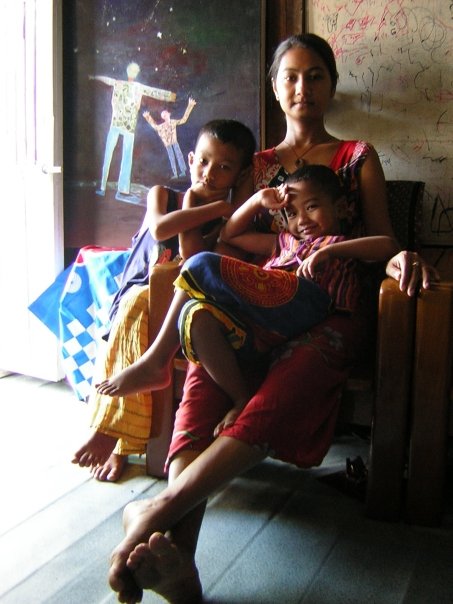
Khet Mar and her two sons in Rangoon, Burma
Photo: © Than Htay Maung
Arriving here in March 2009, Khet Mar, City of Asylum/Pittsburgh’s current writer-in-residence, journeyed with her family on a 45-hour trip from her home in Rangoon, Burma all the way to Sampsonia Way. Living with her husband Than Htay Maung and two sons, Khet Mar has resided on Sampsonia Way now for just over a year.
Since she was young, Khet Mar has written short stories, essays, and poems and continues to do so today on Sampsonia Way. Currently writing a short story, she is preparing to write her very second novel. But, at this point she is still trying to organize her thoughts.
Coming up in July, Khet Mar plans to partake in two readings of her previous work. She normally takes part in readings at local high schools, universities, museums, and at literary discussions about the Burmese community.
One of Khet Mar’s most recent hobbies since moving to America has been her garden.
“I’m currently planting flowers and vegetables in my backyard. I love gardening and seeing flowers grow. I walk in my neighborhood’s streets almost everyday and see the flowers that others have planted. I enjoy doing this a lot. One of my favorite places is my garden, where I can talk with the flowers and the plants. Another favorite place of mine is the bedroom, where I can travel in my thoughts and where I can just read.”
Khet Mar and her family in front of downtown Pittsburgh
Photo: © Khet Mar

Khet Mar’s family is making sure they keep equally as busy with their new lives in Pittsburgh. While Khet Mar writes, her husband is painting a mural on the side of their home, and their children attending school and will soon go to summer camp. Both Khet Mar and her husband are studying at the GPLC (Greater Pittsburgh Literary Council) to help improve their written and spoken English.
“My family likes Pittsburgh very much. I like it too. A class mate of mine, who came here from Poland, told me she feels like the people from Pittsburgh are not welcoming to her family. I do not know what the difference is between her family and my family because not only the people of Pittsburgh but, also the rivers, bridges, trees and flowers welcomed us warmly.”
“Sometimes, I am thinking that I am in a dream. As a young woman who grew up in a fishing village and learned how difficult it was to survive; I never expected that kind of life I now have at City of Asylum/Pittsburgh. Now I am living safely and peacefully in the most livable city in the US. Our luck is very difficult to believe.”
Sunday, 6 June 2010
DEMOCRACY FOR CHINA: WHAT WILL IT TAKE?
PLEASE CIRCULATE
By Roland Watson
June 4, 2010
INTRODUCTION
The most populous nation in the world, China, is a dictatorship. It has been ruled for the last sixty-one years by the Communist Party (CCP). Under Mao Zedong, the CCP was a typical communist regime. The population was kept equal – equally poor. Since Deng Xiaoping, it has become more properly a “capitalist dictatorship.” China today has great, and still growing, inequality. It is a merger of the worst in authoritarian political and economic rule.
The CCP provides material and/or diplomatic support to many other dictatorial regimes around the world. These include: North Korea, Burma, Laos, Cambodia, the members of the Shanghai Cooperation Organization (Kazakhstan, Kyrgyzstan, Tajikistan, Uzbekistan), Russia, Belarus, Iran, Sudan, Zimbabwe, Equatorial Guinea, Angola, Democratic Republic of the Congo, Cuba, and Venezuela. In addition, Tibet, East Turkestan and Southern Mongolia are so dominated by the CCP – for the moment at least – that they have been annexed into China itself.
We should also not forget all of the problems that emanate from China and which affect the entire planet. These include support for the rogue nuclear states North Korea and Iran (and now Burma); the host of deadly consumer products that have been exported from China (and which the CCP refuses to regulate); as well as wide-ranging environmental abuses. The last extends from an uncontrolled demand for timber, mineral resources and endangered species, which is driving environmental destruction and extinction throughout the earth; to air-borne industrial pollution which circulates it; as well as the CCP's maneuvering last year in Copenhagen to sabotage international efforts to address climate change.
China's more than one billion people are being denied freedom and human rights. The CCP's client states have a total population that approaches another billion, and which similarly are denied their rights. Approximately one-third of the world's population is repressed, either directly or indirectly, due to the CCP.
All of these countries, starting with China, have human rights movements and associated advocacy groups, which protest against the manifold ways in which the regimes abuse the peoples' rights. Many of these groups, though, while laudable, in particular because of the dangers – of arrest and torture, even murder – that their leaders and members regularly face, are nonetheless based on an incorrect premise. They believe, or at least they act on, the assumption that human rights can be improved without change to the regime itself, in other words, that human rights can coexist with dictatorship.
This is a fallacy. There can be no human rights without democracy. A dictatorship may pay lip service to human rights, even allow the people some specific rights from time to time, but our full spectrum of rights can never be established and preserved within a dictatorial system. Indeed, democracy is a system designed to protect human rights. Dictatorship is predicated on their rejection and abuse.
The people of China, and also Tibet, East Turkestan and Southern Mongolia, will continue to be denied their rights until the CCP loses power and China becomes a democracy. Other dictatorial regimes will continue to receive CCP support. The rest of the world will continue to suffer the problems that arise out of mainland China.
The question, then, is how can the Chinese people achieve democracy? What will this profound transformation require?
CURRENT ENVIRONMENT
The CCP is strong, and its strength is increasing every day. Notwithstanding factionalism within the Party, the leaders are united around the goal to preserve their rule. A key element underlying this unity is the CCP’s wealth. Chinese businesses have profited enormously from the sale of consumer and industrial products, which the world has been happy to buy. The Party takes a substantial percentage of this trade, hence its accumulated reserves of $2.4 trillion. In addition, with its wealth the Party has been rapidly upgrading its military capability. The People's Liberation Army is now equipped with advanced weapons systems that have been internally developed, secured through espionage, or purchased from authoritarian allies such as Russia.
The International Community has been dithering about the rise of the new China. The hunger for cheap goods has convinced the rest of the world to ignore the totalitarian nature of the CCP and its many, many abuses. The Party further has conducted a full-scale charm offensive, buying loyalty from different nations around the globe, particularly in lesser-developed regions and whose own leaders are also authoritarian. China is actually creating a dictatorial block that constitutes a modern form of imperialism. Whereas Rome conquered other nations and peoples by force, China, the new Rome, is doing it quietly and with money.
THE PEOPLE OF CHINA
The natural source for resistance to CCP rule and a demand for democracy is the Chinese public. Within the country's large population, though, there are many different groups. A great number of people actually belong to the Party, or work for or otherwise benefit from it. The CCP further has created the largest propaganda machine in history, which has the dual goals to promote communist rule and to silence all dissent. This propaganda machine is coupled with the similarly largest censorship exercise in history, notably through the Great Firewall that restricts access by the Chinese people to the Internet.
The basic argument that the CCP makes is that “The Party Knows Best.” The leaders are arguing that they are “benevolent dictators,” and that for China this is the only type of political system that will work. (The irony here is that benevolent dictatorship has roots in Confucianism, and the CCP was formed in part to destroy China's ancient traditions. Now, at least in this case, it is embracing them.)
Benevolent dictatorship is the theoretical alternative to democracy. It claims, among other things, that people are unable to govern themselves: that like sheep we must be led. This is certainly arguable, but the position also has numerous obvious flaws. How do we choose who gets to lead, and how do we prevent them from abusing their power? As China saw under Mao, absolute power often has horrific consequences. And, even if under a particular ruler, or emperor, life is good, there is no guarantee that the next will also be benevolent. Indeed, the odds are, as Rome itself experienced, that tyrants will follow just leaders. Finally, as the people in such a society experience abuse, they become resentful and ultimately attempt to rebel. It is an inevitable cycle with this type of system.
In China, CCP members and cronies, and some portion of the general population, accept dictatorship. Most people, though, cannot be bothered with political concerns. They are too absorbed with their daily struggle to worry about such matters.
Contrasting the pro-regime factions, and on the other side of the silent majority, is an active and growing movement for change. This movement, though, is fractured. The largest elements are human rights groups, which are seeking relief for a wide variety of problems, including corruption, inequitable land distribution, sweatshop working conditions, religious persecution, political prisoners, and environmental crimes. A key participant here is the Falun Gong, which is seeking freedom to practice its spiritual exercises. This is a human rights motivation, and it is notable that the Falun Gong fully supports Confucian ideals.
The largest independent “internal” movements, for Tibet, East Turkestan and Southern Mongolia, also focus on improving human rights, for the Tibetan, Uyghur and Mongolian peoples, not an outright demand for freedom and independence (although such groups have made it clear that they support democracy in China as well). The few internal groups that actually focus on democracy are small (although they are highly motivated), and include the Charter 08 movement and the China Democracy Party.
Finally, there is a large population of Chinese people who reside outside the mainland yet have an active concern for its problems. Many of these people advocate through groups that focus, once again, on human rights issues. A few, though, such as the international branches of the China Democracy Party, and also the Overseas Chinese Democracy Coalition, concentrate their efforts on opposition to the CCP and the need for a transition to democracy.
HOW TO CHANGE CHINA TO A DEMOCRACY
The world for the most part backs the CCP. Multinational corporations have lobbied countless governments to ignore the regime’s abuses and to accept the idea that trade with China is acceptable. Also, while the U.S. has consistently held this position as well, it did periodically speak up for democracy and human rights. Under President Obama, though, these gestures have been suspended. The American government is openly “pragmatic.” (One would have thought that the Obama Administration would choose progressive values over corporate lobby positions.)
This means that the burden for change falls to the Chinese people. Of course, one can argue that this is as it should be. People are responsible for themselves, and if they are the subjects of tyrannical rule, they must lead the way to overthrow it.
The problem with China then is how can Chinese people who are already pro-democracy activists encourage more people, ultimately a critical mass of the population, to support this change. There are two factors here. First, the Chinese need to be taught about democracy. They need to understand the ideas on which democracy is based; why it is preferable to benevolent dictatorship; and also the different aspects and variations of the democratic system that are in use around the world. This way they will become politicized, and develop a strong desire for democracy, and through this a willingness to act, and sacrifice, to fulfill this desire.
Secondly, they need to learn that human rights are predicated on democracy. If they want human rights for China, and if their own rights have been abused, in addition to making such a demand, and protesting such abuses, they should join the movement for democratic change. The Charter 08 document and the China Democracy Party should have millions of signatures and members.
The challenge of course is disseminating this education in the face of the CCP’s propaganda and Internet blockade. It is here that the International Community can be of assistance. The Great Chinese Firewall is not impregnable. Initiatives such as the Global Internet Freedom Consortium, through which Chinese people can bypass the Firewall, are already having a large impact. (The Falun Gong is the primary organizer of the GIFC.) The democratic nations of the world, notably the U.S. (which has budgeted large sums to support the GIFC, but dispensed only a small amount), should do everything possible to create a free information flow. And, all democratic nations and groupings, e.g., the E.U., should again make democracy and human rights the foundation of their foreign policy for China.
Will China require a revolution? Must there be a pro-democracy revolution to erase the results of the 1949 communist revolution? One would hope not: that democratic change can be accomplished in China non-violently. Unfortunately, however, having hopes and dreams does not guarantee that they will come true. In the real world change to democracy has invariably been accompanied by either a popular uprising or a military coup, or both.
As a result of the global financial crisis, business activity in China began to slow down and popular unrest to escalate. I have argued for years that there should be a global boycott of consumer products from China. Call it tough love, or whatever you like, but the Chinese people do have the power to overthrow the CCP. A little push wouldn’t hurt. Then, when China is free, trade can be resumed and the proceeds used to build schools and hospitals, not guns and missiles.
CONCLUSION
Two things are certain with China. For the first, democracy is preferable to the rule of the CCP, but defeating the Party and establishing it will be difficult. All human rights groups, including the Falun Gong, Tibetans, East Turkestanis and Southern Mongolians, should actively organize – both underground operations and international diplomacy – for democratic change. Indeed, if they maintain their primary focus on human rights concerns, such concerns will never be resolved.
Secondly, we, the people of the world, can work to make a difference. If our own political leaders, because of corporate lobbying, choose to back the CCP, we can act on our own to help the Chinese people.
Other than activism within China, the biggest impetus for change will be if either of the neighboring regimes in North Korea and Burma collapse. We can help bring this about as well.
The CCP’s goal is to create a one thousand year empire, that dominates a globe filled with authoritarian allies. This is identical to Adolf Hitler’s dream. Everyone who enjoys or aspires to freedom must work to prevent this from happening.
Dictator Watch
MORE ARTICLES ON BURMA DEMOCRACY
www.dictatorwatch.org
By Roland Watson
June 4, 2010
INTRODUCTION
The most populous nation in the world, China, is a dictatorship. It has been ruled for the last sixty-one years by the Communist Party (CCP). Under Mao Zedong, the CCP was a typical communist regime. The population was kept equal – equally poor. Since Deng Xiaoping, it has become more properly a “capitalist dictatorship.” China today has great, and still growing, inequality. It is a merger of the worst in authoritarian political and economic rule.
The CCP provides material and/or diplomatic support to many other dictatorial regimes around the world. These include: North Korea, Burma, Laos, Cambodia, the members of the Shanghai Cooperation Organization (Kazakhstan, Kyrgyzstan, Tajikistan, Uzbekistan), Russia, Belarus, Iran, Sudan, Zimbabwe, Equatorial Guinea, Angola, Democratic Republic of the Congo, Cuba, and Venezuela. In addition, Tibet, East Turkestan and Southern Mongolia are so dominated by the CCP – for the moment at least – that they have been annexed into China itself.
We should also not forget all of the problems that emanate from China and which affect the entire planet. These include support for the rogue nuclear states North Korea and Iran (and now Burma); the host of deadly consumer products that have been exported from China (and which the CCP refuses to regulate); as well as wide-ranging environmental abuses. The last extends from an uncontrolled demand for timber, mineral resources and endangered species, which is driving environmental destruction and extinction throughout the earth; to air-borne industrial pollution which circulates it; as well as the CCP's maneuvering last year in Copenhagen to sabotage international efforts to address climate change.
China's more than one billion people are being denied freedom and human rights. The CCP's client states have a total population that approaches another billion, and which similarly are denied their rights. Approximately one-third of the world's population is repressed, either directly or indirectly, due to the CCP.
All of these countries, starting with China, have human rights movements and associated advocacy groups, which protest against the manifold ways in which the regimes abuse the peoples' rights. Many of these groups, though, while laudable, in particular because of the dangers – of arrest and torture, even murder – that their leaders and members regularly face, are nonetheless based on an incorrect premise. They believe, or at least they act on, the assumption that human rights can be improved without change to the regime itself, in other words, that human rights can coexist with dictatorship.
This is a fallacy. There can be no human rights without democracy. A dictatorship may pay lip service to human rights, even allow the people some specific rights from time to time, but our full spectrum of rights can never be established and preserved within a dictatorial system. Indeed, democracy is a system designed to protect human rights. Dictatorship is predicated on their rejection and abuse.
The people of China, and also Tibet, East Turkestan and Southern Mongolia, will continue to be denied their rights until the CCP loses power and China becomes a democracy. Other dictatorial regimes will continue to receive CCP support. The rest of the world will continue to suffer the problems that arise out of mainland China.
The question, then, is how can the Chinese people achieve democracy? What will this profound transformation require?
CURRENT ENVIRONMENT
The CCP is strong, and its strength is increasing every day. Notwithstanding factionalism within the Party, the leaders are united around the goal to preserve their rule. A key element underlying this unity is the CCP’s wealth. Chinese businesses have profited enormously from the sale of consumer and industrial products, which the world has been happy to buy. The Party takes a substantial percentage of this trade, hence its accumulated reserves of $2.4 trillion. In addition, with its wealth the Party has been rapidly upgrading its military capability. The People's Liberation Army is now equipped with advanced weapons systems that have been internally developed, secured through espionage, or purchased from authoritarian allies such as Russia.
The International Community has been dithering about the rise of the new China. The hunger for cheap goods has convinced the rest of the world to ignore the totalitarian nature of the CCP and its many, many abuses. The Party further has conducted a full-scale charm offensive, buying loyalty from different nations around the globe, particularly in lesser-developed regions and whose own leaders are also authoritarian. China is actually creating a dictatorial block that constitutes a modern form of imperialism. Whereas Rome conquered other nations and peoples by force, China, the new Rome, is doing it quietly and with money.
THE PEOPLE OF CHINA
The natural source for resistance to CCP rule and a demand for democracy is the Chinese public. Within the country's large population, though, there are many different groups. A great number of people actually belong to the Party, or work for or otherwise benefit from it. The CCP further has created the largest propaganda machine in history, which has the dual goals to promote communist rule and to silence all dissent. This propaganda machine is coupled with the similarly largest censorship exercise in history, notably through the Great Firewall that restricts access by the Chinese people to the Internet.
The basic argument that the CCP makes is that “The Party Knows Best.” The leaders are arguing that they are “benevolent dictators,” and that for China this is the only type of political system that will work. (The irony here is that benevolent dictatorship has roots in Confucianism, and the CCP was formed in part to destroy China's ancient traditions. Now, at least in this case, it is embracing them.)
Benevolent dictatorship is the theoretical alternative to democracy. It claims, among other things, that people are unable to govern themselves: that like sheep we must be led. This is certainly arguable, but the position also has numerous obvious flaws. How do we choose who gets to lead, and how do we prevent them from abusing their power? As China saw under Mao, absolute power often has horrific consequences. And, even if under a particular ruler, or emperor, life is good, there is no guarantee that the next will also be benevolent. Indeed, the odds are, as Rome itself experienced, that tyrants will follow just leaders. Finally, as the people in such a society experience abuse, they become resentful and ultimately attempt to rebel. It is an inevitable cycle with this type of system.
In China, CCP members and cronies, and some portion of the general population, accept dictatorship. Most people, though, cannot be bothered with political concerns. They are too absorbed with their daily struggle to worry about such matters.
Contrasting the pro-regime factions, and on the other side of the silent majority, is an active and growing movement for change. This movement, though, is fractured. The largest elements are human rights groups, which are seeking relief for a wide variety of problems, including corruption, inequitable land distribution, sweatshop working conditions, religious persecution, political prisoners, and environmental crimes. A key participant here is the Falun Gong, which is seeking freedom to practice its spiritual exercises. This is a human rights motivation, and it is notable that the Falun Gong fully supports Confucian ideals.
The largest independent “internal” movements, for Tibet, East Turkestan and Southern Mongolia, also focus on improving human rights, for the Tibetan, Uyghur and Mongolian peoples, not an outright demand for freedom and independence (although such groups have made it clear that they support democracy in China as well). The few internal groups that actually focus on democracy are small (although they are highly motivated), and include the Charter 08 movement and the China Democracy Party.
Finally, there is a large population of Chinese people who reside outside the mainland yet have an active concern for its problems. Many of these people advocate through groups that focus, once again, on human rights issues. A few, though, such as the international branches of the China Democracy Party, and also the Overseas Chinese Democracy Coalition, concentrate their efforts on opposition to the CCP and the need for a transition to democracy.
HOW TO CHANGE CHINA TO A DEMOCRACY
The world for the most part backs the CCP. Multinational corporations have lobbied countless governments to ignore the regime’s abuses and to accept the idea that trade with China is acceptable. Also, while the U.S. has consistently held this position as well, it did periodically speak up for democracy and human rights. Under President Obama, though, these gestures have been suspended. The American government is openly “pragmatic.” (One would have thought that the Obama Administration would choose progressive values over corporate lobby positions.)
This means that the burden for change falls to the Chinese people. Of course, one can argue that this is as it should be. People are responsible for themselves, and if they are the subjects of tyrannical rule, they must lead the way to overthrow it.
The problem with China then is how can Chinese people who are already pro-democracy activists encourage more people, ultimately a critical mass of the population, to support this change. There are two factors here. First, the Chinese need to be taught about democracy. They need to understand the ideas on which democracy is based; why it is preferable to benevolent dictatorship; and also the different aspects and variations of the democratic system that are in use around the world. This way they will become politicized, and develop a strong desire for democracy, and through this a willingness to act, and sacrifice, to fulfill this desire.
Secondly, they need to learn that human rights are predicated on democracy. If they want human rights for China, and if their own rights have been abused, in addition to making such a demand, and protesting such abuses, they should join the movement for democratic change. The Charter 08 document and the China Democracy Party should have millions of signatures and members.
The challenge of course is disseminating this education in the face of the CCP’s propaganda and Internet blockade. It is here that the International Community can be of assistance. The Great Chinese Firewall is not impregnable. Initiatives such as the Global Internet Freedom Consortium, through which Chinese people can bypass the Firewall, are already having a large impact. (The Falun Gong is the primary organizer of the GIFC.) The democratic nations of the world, notably the U.S. (which has budgeted large sums to support the GIFC, but dispensed only a small amount), should do everything possible to create a free information flow. And, all democratic nations and groupings, e.g., the E.U., should again make democracy and human rights the foundation of their foreign policy for China.
Will China require a revolution? Must there be a pro-democracy revolution to erase the results of the 1949 communist revolution? One would hope not: that democratic change can be accomplished in China non-violently. Unfortunately, however, having hopes and dreams does not guarantee that they will come true. In the real world change to democracy has invariably been accompanied by either a popular uprising or a military coup, or both.
As a result of the global financial crisis, business activity in China began to slow down and popular unrest to escalate. I have argued for years that there should be a global boycott of consumer products from China. Call it tough love, or whatever you like, but the Chinese people do have the power to overthrow the CCP. A little push wouldn’t hurt. Then, when China is free, trade can be resumed and the proceeds used to build schools and hospitals, not guns and missiles.
CONCLUSION
Two things are certain with China. For the first, democracy is preferable to the rule of the CCP, but defeating the Party and establishing it will be difficult. All human rights groups, including the Falun Gong, Tibetans, East Turkestanis and Southern Mongolians, should actively organize – both underground operations and international diplomacy – for democratic change. Indeed, if they maintain their primary focus on human rights concerns, such concerns will never be resolved.
Secondly, we, the people of the world, can work to make a difference. If our own political leaders, because of corporate lobbying, choose to back the CCP, we can act on our own to help the Chinese people.
Other than activism within China, the biggest impetus for change will be if either of the neighboring regimes in North Korea and Burma collapse. We can help bring this about as well.
The CCP’s goal is to create a one thousand year empire, that dominates a globe filled with authoritarian allies. This is identical to Adolf Hitler’s dream. Everyone who enjoys or aspires to freedom must work to prevent this from happening.
Dictator Watch
MORE ARTICLES ON BURMA DEMOCRACY
www.dictatorwatch.org
Sunday, 14 March 2010
Rigging Myanmar's election Belt, braces and army boots
THE junta ruling Myanmar has had 20 years to digest the lessons from the country’s most recent election. It was trounced by the National League for Democracy, even though the opposition’s charismatic leader, Aung San Suu Kyi, was already under house arrest. This year on an unnamed date (perhaps its astrologers cannot agree) the junta will hold another election. It will not lose this one.
Election laws published this week do not quite spell out the result. But a “political-parties registration law” bars Miss Suu Kyi and other political prisoners, of whom there are more than 2,000, from belonging to a party because of their criminal convictions. Cut off from politics by her house arrest, Miss Suu Kyi is anyway barred from office as the widow of a foreigner. Her party now has to expel her and other detainees. The law also bans civil servants from joining parties, along with monks, who led anti-government protests in 2007.
The dilemma the opposition faces has become sharper. It has long had to worry about whether to add legitimacy to a sham electoral process by taking part, or risk further marginalisation by boycotting it. Now the League has been allowed to reopen branch offices closed since 2003. But it has 60 days to decide, in effect, between taking part in the election and abolition as a legal party. In 1995 it pulled out of a farcical “national convention” drafting a new constitution. The constitution that emerged in 2008 duly enshrines the role of the army. This time the League may feel compelled to take part, but find that just as ineffectual.
The election, nonetheless, does come at a time of some sort of change, if only generational. Than Shwe, the “senior general” (pictured), is 77. He and his comrades are preparing to pass on the baton. Western diplomats hope that, having cut their teeth fighting a Chinese-backed communist insurgency, they are uneasy with Myanmar’s isolation from the West and loth to bequeath their successors a regime so reliant on China. The election, one stop on a “road map” to democracy, in this analysis, is one way of opening up.
In another change the junta has started a remarkable if stealthy process of selling state assets: ports, buildings in Yangon vacated by its shift of capital in 2005, petrol stations, telecoms firms and a share in the national airline. This is hardly a gesture to economic reform—the sales are cooked-up deals benefiting junta cronies. But nor does it seem just the desperation of a cash-strapped regime. Rather, in the analysis of Yeni, of the Irrawaddy, a magazine published by émigrés in Thailand, it is the “formal transfer of the nation’s wealth into the hands of an entrenched elite”, ahead of an election and the implementation of a new constitution which, in theory, should allow greater competition for assets. This elite is “pre-emptively buying up everything in sight”. It has a similar attitude to competition of the democratic kind.
Election laws published this week do not quite spell out the result. But a “political-parties registration law” bars Miss Suu Kyi and other political prisoners, of whom there are more than 2,000, from belonging to a party because of their criminal convictions. Cut off from politics by her house arrest, Miss Suu Kyi is anyway barred from office as the widow of a foreigner. Her party now has to expel her and other detainees. The law also bans civil servants from joining parties, along with monks, who led anti-government protests in 2007.
The dilemma the opposition faces has become sharper. It has long had to worry about whether to add legitimacy to a sham electoral process by taking part, or risk further marginalisation by boycotting it. Now the League has been allowed to reopen branch offices closed since 2003. But it has 60 days to decide, in effect, between taking part in the election and abolition as a legal party. In 1995 it pulled out of a farcical “national convention” drafting a new constitution. The constitution that emerged in 2008 duly enshrines the role of the army. This time the League may feel compelled to take part, but find that just as ineffectual.
The election, nonetheless, does come at a time of some sort of change, if only generational. Than Shwe, the “senior general” (pictured), is 77. He and his comrades are preparing to pass on the baton. Western diplomats hope that, having cut their teeth fighting a Chinese-backed communist insurgency, they are uneasy with Myanmar’s isolation from the West and loth to bequeath their successors a regime so reliant on China. The election, one stop on a “road map” to democracy, in this analysis, is one way of opening up.
In another change the junta has started a remarkable if stealthy process of selling state assets: ports, buildings in Yangon vacated by its shift of capital in 2005, petrol stations, telecoms firms and a share in the national airline. This is hardly a gesture to economic reform—the sales are cooked-up deals benefiting junta cronies. But nor does it seem just the desperation of a cash-strapped regime. Rather, in the analysis of Yeni, of the Irrawaddy, a magazine published by émigrés in Thailand, it is the “formal transfer of the nation’s wealth into the hands of an entrenched elite”, ahead of an election and the implementation of a new constitution which, in theory, should allow greater competition for assets. This elite is “pre-emptively buying up everything in sight”. It has a similar attitude to competition of the democratic kind.
Tuesday, 11 November 2008
Burma six months on: Children and their families are still in need of international assistance
11 Nov 2008 05:39:48 GMT
(Alert Net) - Cyclone Nargis cut a swath of destruction across Myanmar’s southern coast on 2-3 May 2008.
More than 130,000 people, including tens of thousands of children, died or disappeared, while more than 1 million people lost their homes. In addition, the agriculture and fishing industries in the Irrawaddy Delta were devastated, leaving families with no way to earn an income or feed themselves.
The storm also flooded low-lying areas, contaminating wells, containment ponds and rivers. Salinity of these traditional sources of drinking water remains high. As the dry season begins this month in Myanmar, families will have few options for obtaining clean drinking water, increasing the risk of disease.
“The water shortage that typically comes with the dry season is being exacerbated by the unusually high salt content in water sources in the Delta — a lingering result of the cyclone,” said Andrew Kirkwood, Save the Children’s country director in Myanmar. “The lack of clean water will directly impact the health of children. Scarce family resources will be further strained if they must purchase water, as will relationships among communities if they must compete for this resource.”
Source: Save the Children - Australia
Reuters and AlertNet are not responsible for the content of this article or for any external internet sites. The views expressed are the author's alone.
(Alert Net) - Cyclone Nargis cut a swath of destruction across Myanmar’s southern coast on 2-3 May 2008.
More than 130,000 people, including tens of thousands of children, died or disappeared, while more than 1 million people lost their homes. In addition, the agriculture and fishing industries in the Irrawaddy Delta were devastated, leaving families with no way to earn an income or feed themselves.
The storm also flooded low-lying areas, contaminating wells, containment ponds and rivers. Salinity of these traditional sources of drinking water remains high. As the dry season begins this month in Myanmar, families will have few options for obtaining clean drinking water, increasing the risk of disease.
“The water shortage that typically comes with the dry season is being exacerbated by the unusually high salt content in water sources in the Delta — a lingering result of the cyclone,” said Andrew Kirkwood, Save the Children’s country director in Myanmar. “The lack of clean water will directly impact the health of children. Scarce family resources will be further strained if they must purchase water, as will relationships among communities if they must compete for this resource.”
Source: Save the Children - Australia
Reuters and AlertNet are not responsible for the content of this article or for any external internet sites. The views expressed are the author's alone.
Sunday, 2 November 2008
Comparison of BSPP's and SPDC's Political Manipulation
Wed 29 Oct 2008 (Mon News) - The Burmese Army took power not during the bloodshed of 1988, but through a coup in 1962. The military has ruled the country under many different names. The commanders of Burma’s Army have noticed how delicious power tastes, and do not want the make way for democratic governance. They continuously manipulate the situation in Burma to maintain power. They will again during the election of 2010.
Under the name “Revolutionary Council,” General Ne Win ruled the country from 1962 to 1974. He ruled without any constitution, like the State Law and Order Restoration Council (SLORC) – and subsequent State Peace and Development Council (SPDC) – ruled from 1988 to 2008, and maybe will past 2010.
Ne Win imprisoned hundreds of democratic and ethnic leaders, including former Prime Minister U Nu and Mon leaders Nai Aung Tun. Similarly, SLORC's Gen. Saw Maung and Lt. Gen. Khin Nyunt arrested many activists – student leaders, NLD members and 1990 MPs – and imprisoned them for many years. SPDC's Sr. Gen. Than Shwe has been more aggressive and notorious. He ordered the imprisonment of almost all of ‘88 Generation Student leaders and killed unarmed monks and civilians during the 2007 September's Saffron Revolution.
Ruling the country without a legitimate constitution is lawlessness. And it is illegitimate in the eyes of international and diplomatic communities. Ne Win and his military men drafted a socialist constitution in 1974 and called for a sham “People’s Referendum.” Unsurprisingly, 99% of the people were said to support the one-party rule Socialist Constitution. Burmese Army's commanders took off their uniform, and took over politics through one-party elections and seats in the parliament and cabinet.
History is repeating itself. The SPDC's Sr. Gen. Than Shwe held a sham “National Convention” to draft a sham constitution. The product guarantees the military controls 25% of seats in parliament. After the 2010 Elections, the military will rule without taking off a uniform.
If compared with these situation, the current regime more openly expresses that they love the taste of power and will continue military rule of the country as long as possible. As prominent Journalist U Win Tin said, “all of us will die in this roadmap.” This roadmap cleared the way for military rule and it is the genuine political will of this regime. Therefore, there will be no liberal or participatory democracy in Burma.
Under the name “Revolutionary Council,” General Ne Win ruled the country from 1962 to 1974. He ruled without any constitution, like the State Law and Order Restoration Council (SLORC) – and subsequent State Peace and Development Council (SPDC) – ruled from 1988 to 2008, and maybe will past 2010.
Ne Win imprisoned hundreds of democratic and ethnic leaders, including former Prime Minister U Nu and Mon leaders Nai Aung Tun. Similarly, SLORC's Gen. Saw Maung and Lt. Gen. Khin Nyunt arrested many activists – student leaders, NLD members and 1990 MPs – and imprisoned them for many years. SPDC's Sr. Gen. Than Shwe has been more aggressive and notorious. He ordered the imprisonment of almost all of ‘88 Generation Student leaders and killed unarmed monks and civilians during the 2007 September's Saffron Revolution.
Ruling the country without a legitimate constitution is lawlessness. And it is illegitimate in the eyes of international and diplomatic communities. Ne Win and his military men drafted a socialist constitution in 1974 and called for a sham “People’s Referendum.” Unsurprisingly, 99% of the people were said to support the one-party rule Socialist Constitution. Burmese Army's commanders took off their uniform, and took over politics through one-party elections and seats in the parliament and cabinet.
History is repeating itself. The SPDC's Sr. Gen. Than Shwe held a sham “National Convention” to draft a sham constitution. The product guarantees the military controls 25% of seats in parliament. After the 2010 Elections, the military will rule without taking off a uniform.
If compared with these situation, the current regime more openly expresses that they love the taste of power and will continue military rule of the country as long as possible. As prominent Journalist U Win Tin said, “all of us will die in this roadmap.” This roadmap cleared the way for military rule and it is the genuine political will of this regime. Therefore, there will be no liberal or participatory democracy in Burma.
The Faltering Asean Way
By MICHAEL VATIKIOTIS
The Irrawaddy News
It is ironic that just as the much-heralded Asean Charter received its final approval through ratification by Indonesia, two Asean member states faced off across a disputed patch of land and started shooting at each other. It was an inauspicious start to what the Charter's preamble refers to as 'a region of lasting peace, security and stability...'
The Thai-Cambodian border is not the only fault line that threatens peace in South-east Asia. In recent weeks, Malaysia has rattled Indonesian nerves with the threatened exploitation of disputed waters off the island of Borneo. The reaction in Jakarta? Instead of requesting the good offices of the Asean Secretary-General to mediate as envisaged in the Charter, security agencies hurriedly planned a military exercise to practice confrontation with the Malaysian navy.
Southeast Asian nations have lived in relative peace and harmony for the past half-century. But they have been reluctant up till now to formalize the mechanism by which peace is maintained. Asean member states have displayed an allergy to formal security cooperation. They have preferred instead to use informal channels and personal connections to resolve disputes.
This was a fine arrangement when Southeast Asia was a more clubbable place, its leaders more or less on the same political plane, sharing the same demons (communist insurgency and uppity peasantry). But today, Southeast Asia has become a patchwork of rather different political landscapes.
In Indonesia, a vibrant democracy has injected nationalist stridency to the country's diplomacy. In Thailand, bitter domestic political conflict is doing the same as one side seeks to undermine the other by questioning its nationalist credentials. In the Philippines, the legislature holds the threat of impeachment over the President's head and makes it hard for the country's chief executive to follow a consistent foreign policy agenda.
Pluralism, therefore, is making it hard for Asean officials to knit together the much-vaunted regional consensus. Now more than ever, Asean needs to build a framework for dispute resolution that will allow the collective security of the region to trump domestic politics and nationalist breast-beating. The Asean Charter lays a good foundation for doing so.
But despite the Charter's ratification, there are few signs this is happening. The other day when Thai and Cambodian troops started trading fire, Asean officials were at a loss to know how to intervene. Asean Secretary-General Surin Pitsuwan asked regional leaders like Indonesia's President Susilo Bambang Yudhoyono to appeal for restraint, which he did. Foreign ministers from Indonesia and Malaysia fell over themselves to offer mediation, but no invitation came from either of the parties. The current Asean chairman, Thailand, is a party to the dispute.
Eventually, calm was restored when it emerged that the Thai and Cambodian leaders would meet on the fringes of an Asia-Europe meeting in Beijing, which they did. That is hardly an endorsement of Asean's ability to resolve disputes.
At the heart of the problem is the reluctance of Asean member states to yield an inch of sovereignty in the interests of collective security. The past few months have seen a number of attempts to gently push the boundaries of acceptable intervention, but it has not been easy.
Witness how easily domestic politics derailed a Malaysian-brokered deal between Manila and the Moro Islamic Liberation Front in Mindanao. Often, when regional mediation does get under way, jealous or competitive neighbors seek to sabotage or hamper these efforts. Not only has Bangkok been reluctant to embrace Jakarta's good offices as a mediator in the southern Thailand conflict, but also Malaysia appears to be unhappy to see Jakarta involved in a dispute along its border with Thailand.
Ever since the high-profile resolution of the long-running conflict in Aceh on the back of the devastating December 2004 tsunami, many in the region saw the so-called 'Aceh model' as a path to peacemaking easily replicated elsewhere, which is not necessarily the case.
Without a more formal mechanism to channel and regulate conflict management, with the implicit role of third-party intervention, Asean's efforts to forge a region of peace and security will fall on stony ground. There is something of a built-in contradiction between bedrock principles in the Asean Charter: on the one hand, it stresses respect for sovereignty and territorial integrity; and on the other, a 'shared commitment and collective responsibility' for peace and security. Put another way: How can Asean ensure the peaceful resolution of disputes when the Charter insists on non-interference in the internal affairs of member states?
This contradiction needs resolving.
When neighbours cannot settle quarrels between themselves, outsiders should be called on to do so. The irony of not allowing more space for regional mediation is that it leaves the door open for larger powers—like China in the case of the current Thai-Cambodian dispute—to act as the mediator.
The writer is Asia Regional Director for the Geneva-based Centre for Humanitarian Dialogue and this article recently appeared on Jakarta Post.
The Irrawaddy News
It is ironic that just as the much-heralded Asean Charter received its final approval through ratification by Indonesia, two Asean member states faced off across a disputed patch of land and started shooting at each other. It was an inauspicious start to what the Charter's preamble refers to as 'a region of lasting peace, security and stability...'
The Thai-Cambodian border is not the only fault line that threatens peace in South-east Asia. In recent weeks, Malaysia has rattled Indonesian nerves with the threatened exploitation of disputed waters off the island of Borneo. The reaction in Jakarta? Instead of requesting the good offices of the Asean Secretary-General to mediate as envisaged in the Charter, security agencies hurriedly planned a military exercise to practice confrontation with the Malaysian navy.
Southeast Asian nations have lived in relative peace and harmony for the past half-century. But they have been reluctant up till now to formalize the mechanism by which peace is maintained. Asean member states have displayed an allergy to formal security cooperation. They have preferred instead to use informal channels and personal connections to resolve disputes.
This was a fine arrangement when Southeast Asia was a more clubbable place, its leaders more or less on the same political plane, sharing the same demons (communist insurgency and uppity peasantry). But today, Southeast Asia has become a patchwork of rather different political landscapes.
In Indonesia, a vibrant democracy has injected nationalist stridency to the country's diplomacy. In Thailand, bitter domestic political conflict is doing the same as one side seeks to undermine the other by questioning its nationalist credentials. In the Philippines, the legislature holds the threat of impeachment over the President's head and makes it hard for the country's chief executive to follow a consistent foreign policy agenda.
Pluralism, therefore, is making it hard for Asean officials to knit together the much-vaunted regional consensus. Now more than ever, Asean needs to build a framework for dispute resolution that will allow the collective security of the region to trump domestic politics and nationalist breast-beating. The Asean Charter lays a good foundation for doing so.
But despite the Charter's ratification, there are few signs this is happening. The other day when Thai and Cambodian troops started trading fire, Asean officials were at a loss to know how to intervene. Asean Secretary-General Surin Pitsuwan asked regional leaders like Indonesia's President Susilo Bambang Yudhoyono to appeal for restraint, which he did. Foreign ministers from Indonesia and Malaysia fell over themselves to offer mediation, but no invitation came from either of the parties. The current Asean chairman, Thailand, is a party to the dispute.
Eventually, calm was restored when it emerged that the Thai and Cambodian leaders would meet on the fringes of an Asia-Europe meeting in Beijing, which they did. That is hardly an endorsement of Asean's ability to resolve disputes.
At the heart of the problem is the reluctance of Asean member states to yield an inch of sovereignty in the interests of collective security. The past few months have seen a number of attempts to gently push the boundaries of acceptable intervention, but it has not been easy.
Witness how easily domestic politics derailed a Malaysian-brokered deal between Manila and the Moro Islamic Liberation Front in Mindanao. Often, when regional mediation does get under way, jealous or competitive neighbors seek to sabotage or hamper these efforts. Not only has Bangkok been reluctant to embrace Jakarta's good offices as a mediator in the southern Thailand conflict, but also Malaysia appears to be unhappy to see Jakarta involved in a dispute along its border with Thailand.
Ever since the high-profile resolution of the long-running conflict in Aceh on the back of the devastating December 2004 tsunami, many in the region saw the so-called 'Aceh model' as a path to peacemaking easily replicated elsewhere, which is not necessarily the case.
Without a more formal mechanism to channel and regulate conflict management, with the implicit role of third-party intervention, Asean's efforts to forge a region of peace and security will fall on stony ground. There is something of a built-in contradiction between bedrock principles in the Asean Charter: on the one hand, it stresses respect for sovereignty and territorial integrity; and on the other, a 'shared commitment and collective responsibility' for peace and security. Put another way: How can Asean ensure the peaceful resolution of disputes when the Charter insists on non-interference in the internal affairs of member states?
This contradiction needs resolving.
When neighbours cannot settle quarrels between themselves, outsiders should be called on to do so. The irony of not allowing more space for regional mediation is that it leaves the door open for larger powers—like China in the case of the current Thai-Cambodian dispute—to act as the mediator.
The writer is Asia Regional Director for the Geneva-based Centre for Humanitarian Dialogue and this article recently appeared on Jakarta Post.
Tuesday, 28 October 2008
Myanmar's failed non-violent opposition
By Norman Robespierre
YANGON - The one-year anniversary of Myanmar's military crackdown on non-violent protests in Yangon and several other cities calling for political change came and went without incident.
While the Buddhist monk-led demonstrations briefly raised global awareness of the Burmese people's plight, it also highlighted the failure of the opposition's long-held non-violence strategy as the best means to bring change to the ruling State Peace and Development Council (SPDC) regime that views the failure to use violence as a sign of weakness.
While outwardly a spontaneous gesture in reaction to economic woes, the demonstrations were the culmination of years of planning by opposition forces inside and abroad for non-violent action to confront the regime. Opposition to the ruling regime is figuratively headed by Aung San Suu Kyi, the daughter of General Aung San, the founding father of Burmese independence. Her commitment to non-violent struggle for political change has earned her the Nobel Peace Prize and global admiration, but two decades since soldiers opened fire on unarmed pro-democracy demonstrators, there is little else to show for her two decades of non-violent struggle.
The resounding victory of Suu Kyi's National League for Democracy (NLD) party in the 1990 elections was the political high-water mark for the opposition. While the regime refused to honor the poll's results, the election provided political legitimacy to the NLD and a handful of opposition activists. Many of those elected still cling to demands that the election's results be honored, but with each passing year those claims to legitimacy become less germane. Close to 40% of the elected members of parliament have been dismissed or resigned and a full 20% have died.
The opposition defined broadly is comprised of a plethora of political organizations. Among the best known are the National Coalition Government for the Union of Burma, headed by Dr Sein Win, Suu Kyi's cousin, the All-Burma Student's Democratic Front (ABSDF), Democratic Alliance for Burma, National League for Democracy-(Liberated Areas).
Additionally, there are several umbrella organizations such as the democratic Alliance for Burma (DAB) and the National Council of the Union of Burma (NCUB), which count membership from various political groups and ethnic insurgent armies. These organizations receive substantial backing from Western organizations, such as the Open Society Institute and National Endowment for Democracy.
The vast majority of the opposition follows Suu Kyi's guidance that political change can and should be achieved through non-violence. That doctrine was further promulgated by the Albert Einstein Institute of Geneva and New York. In 1994, it sponsored a consultation on political defiance for Burmese democracy leaders. Included in the audience were representatives of ABSDF, NLD-LA, DAB, and the NCGUB, represented by Dr Sein Win. A key speaker at the pivotal event was the institute's founder, Gene Sharp.
Sharp's involvement with the Burmese opposition was specifically mentioned in a June 1997 press conference condemning foreign support to terrorists by then Secretary-1of the SPDC, Lieutenant General Khin Nyunt. In hindsight, rather than condemnation, Khin Nyunt should have heaped laurels on Sharp for promoting non-violence.
The opposition's adherence to non-violence has given the regime a monopoly on fear that allowed it to solidify its position, condemning generations of Burmese to life (and in some cases, death) under the military regime. Additionally, limiting the prospect of violent consequences removed one aspect which may have motivated the regime to negotiate change.
Further, the promotion of non-violence undermined the united opposition against the regime. Under the tutelage of Khin Nyunt, the regime succeeded in enticing numerous armed ethnic opposition groups to surrender their arms and "enter the light" - or at least accept a ceasefire. Khin Nyunt used a variety of incentives to the groups and particularly their leaders to gain their cooperation. The elevated principle of non-violence made it easier for group leaders to accept the bribery.
The success of the regime's effort to pursue ceasefire deals continues to haunt the opposition with fragmentation and conflicting interests. Ethnic armies whose cooperation could have tilted the "Saffron" revolution to effect real change, sat and watched, perhaps out of concern that armed rebellion would jeopardize their lucrative mining or other concessions. As a result, the regime was able to focus its military might on the unarmed protesters and monks.
Incentives and self-interest affect not only limited ceasefires and peace groups, but also some ethnic armies that continue to put forces in the field against the Myanmar military, or Tatmadaw. According to a senior Thai military officer, the SPDC is able to continue to benefit from the vulnerable Yadana-Yetagun gas pipelines because the Mon insurgents in the area are receiving payoffs from both the regime and the Thai authorities. Construction of a third foreign exchange earning pipeline in the same area is reportedly slated for this dry season.
A valuable experience
The Einstein Institute's website comments that while the non-violent struggles in Myanmar, China and Tibet "have not brought an end to the ruling dictatorships or occupations, they have exposed the brutal nature of those repressive regimes to the world community and have provided the populations with valuable experience with this form of struggle".
How 20 years of mostly ineffectual resistance can be summed up as a "valuable experience" is a mystery. One wonders to what valuable experience those sitting comfortably in their ideological ivory towers refer: languishing in a Myanmar prison, being knocked senseless by a police truncheon, having family members disappear, torture, death? How much longer before the Burmese people realize the opposition's strategy of non-violence is ineffective against those who have the means and determination to kill to maintain control and decide to pursue a different, more assertive course?
Opposition optimists say that the regime was weakened by last year's crackdown, arguing that the violence police and soldiers perpetrated against Buddhist monks irked the populace and many military officers, the majority of them Buddhist. Further, they cite perennial rumors of infighting among the generals and lower ranks that could lead to fractures in the leadership and eventually a democracy-promoting mutiny.
However, earlier leadership struggles in which top generals fell from grace - including Tun Kyi, Saw Maung, Ne Win and Khin Nyunt - only brought changes in military personalities, not a transformation of the military-dominated system. Indeed, the system is highly resilient and endures with a new crop of military officers entering the top ranks of the Tatmadaw each year. Although many of the officers are not enthusiastic that monks were beaten, most believe that the majority of the protesters were recent novices who had donned monk's robes expressly to carry out illegal political demonstrations.
The optimists also claim that the regime's inadequate response to Cyclone Nargis, which killed over 80,000 people and adversely affected the livelihoods of over 2 million, also weakened the SPDC. As evidence, they mention that many military personnel and government workers had relatives in the worst-hit Ayeyawady Division and were upset at the delayed response. The actual intensity of disenchantment caused by the slow reaction to the killer storm, of course, is hard to quantify without public opinion polls.
However, the fact that Burmese people are used to being self-sufficient and not in the habit of relying on the government for anything likely means the fallout from such a callous official response was less severe than it would have been in other countries. Whatever disenchantment the government's limp response to Nargis and the September 2007 crackdown may have sown, to date it has not been exploited to cause the Tatmadaw to split or the military government to fall.
From another perspective, it could just as easily be argued that Cyclone Nargis made the regime stronger by opening up a new tap of foreign aid. Millions of dollars of humanitarian aid poured into the economy as foreign nations rallied to assist the storm's survivors. The regime's multi-tiered foreign exchange system allowed them to extract an estimated 20% to 25% from all foreign exchange certificates converted into the local kyat currency.
The diversion of United Nations (UN) funds alone resulted in at least US$1.5 million (some estimates are as high as $10 million) of humanitarian aid being delivered straight into the regime's coffers. The tilted exchange system also affected non-UN aid agencies for an undetermined amount of donations. Hard currency intended to relieve the suffering of cyclone survivors instead directly benefited the regime.
Nargis also brought a recent call from the International Crisis Group (ICG) to repeal sanctions and provide more aid than beyond what is necessary to recover from Nargis to develop the impoverished country. While few share the ICG's sentiment, which in the past was criticized by the Open Society Institute for its unscholarly approach with respect to Myanmar, its call would allow the regime to reap even more foreign money to consolidate its position.
Nargis brought not only financial benefit, but also is believed to have increased the regime's confidence. Certainly, the regime's confidence soared when French and US warships withdrew from waters off Myanmar's coast in the aftermath of the killer storm. While the vessels were sent to deliver humanitarian aid, antagonistic rhetoric about the humanitarian "right to protect" Myanmar's citizens by Western diplomats preceded the vessels' arrivals, raising the regime's suspicions about their mission.
Rather than appear to submit to Western threats, and fearful of a possible uprising by opposition activists should foreign forces land on Myanmar soil, the regime barred the aid from being delivered by other than their own naval personnel. Eventually the vessels withdrew without a shot being fired and much of the aid went undelivered. The regime's ability to diplomatically ward off the perceived threat posed by French and American warships is believed to have boosted the regime's confidence in its ability to stand up to neo-colonialist adversaries.
Confidence in the regime's decision-making, often portrayed as daft or worse in the international media, has recently reportedly grown among the rank and file. In particular, the decision to move the political capital to Naypyitaw from Yangon is - after the cyclone which hit the old capital - viewed in a favorable new light. Prior to Nargis, the abrupt move in late 2005 was widely criticized for its exorbitant expense and ridiculed for its reliance on astrology. It is now looked at by many Burmese as cosmic confirmation of the wisdom and even prescience of the senior leadership - or at least that of their astrologers.
More important is the regime's growing confidence in the reliability of government forces to deploy as instruments of control. The ability to successfully extinguish the pro-democracy protests in September 2007, without notable dissension within the ranks of the police and military, left the Tatmadaw stronger and the regime more self-assured. According to several foreign diplomats based in Yangon, the regime is now reportedly more confident in the loyalty of its forces and its ability to control unrest.
On the other hand, the position of the political opposition is decidedly weaker. More opposition members are in prison than before, while countless others have fled the country due to very real concerns for their personal security. An untold number have perished. Despite the overwhelming support of the populace, the opposition was unable to capitalize on social discontent in 2007, when the junta removed fuel price subsidies and fuel costs shot up 500% overnight. Nor have they been able to leverage the chaos and suffering brought on by the junta's inept handling of the cyclone disaster this year into a renewed call for political change.
Instead of maintaining offensive pressure and preparing adequate defensive measures to protect their supporters, they have blindly clung to the gospel of non-violence in the hope that international pressure would eventually lead to democratic change. As many Saffron Revolution demonstrators can attest, hope is a weak defensive shield against a police baton, a charging truck, or the ammunition of soldiers trained to kill.
Asymmetric violence
While pursuing a moral high ground of non-violence, the opposition has ceded the battlefield to its military enemy. Unlike themselves, the ruling SPDC junta is more than willing to use violence to achieve its goals. One means at the regime's disposal are Swan-ar-Shin thugs, whose actions undoubtedly are directed by elements of the military regime, most likely the Sa Ya Pha , or military intelligence. Swan-ar-Shin often intimidate and cower the populace with the threat of violence and physical assault and many were captured on film beating unarmed demonstrators after they had been arrested.
The regime's asymmetric use of violence breeds fear in the populace, forcefully enabling the regime to squash even the faintest hint of opposition to its rule. Viewed through that lens, the Swan-ar-Shin has been an unqualified success for the regime and instrumental in its staying power. Their ability to use violence with impunity and intimidate those holding dissenting political views has muzzled open expression of support for political change.
As the Einstein Institute's Sharp points out in his writings, it is the fear of violent sanctions, rather than the violence itself, that creates the climate of fear which causes the populace to yield. In the absence of a functioning legal system, the opposition would be wise to pursue extra-legal action against the regime's violent henchmen. For instance, makeshift justice squads of the people could be formed to mete out street punishment to the Swan-ar-Shin members known to be guilty of the most heinous abuses.
These Swan-ar-Shin agents are well known to their neighbors and a few instances of vigilante justice would no doubt cause others to consider the consequences of their unjust actions and embolden those who oppose them. While opposition-led vigilante squads may not totally remove the climate of fear, at least fear would be more equally distributed to both sides of the political aisle.
In February, the Democratic Voice of Burma reported on a rare example of focused direct action against the junta's henchmen. According to the report, a regime-linked United Solidarity and Development Association (USDA) member from Hlaing Tharyar township with a local reputation for abuse was found beheaded. The circumstances of his death caused other USDA members to fear a similar fate and their harassment of people noticeably reduced, according to the report. Were this fear of retribution more widespread, the regime would have fewer resources to strangle dissent and added incentive to negotiate with the opposition.
Instead, the exiled opposition blindly adheres to non-violence and is now mounting a major effort to petition the UN to revoke Myanmar's diplomatic credentials. There is nothing original in petitioning the UN: a similar initiative met with no success in 1996 and there is no reason to think the current initiative has any better chance of succeeding. Numerous other countries in the UN General Assembly are also far from being democracies and they would be reluctant to support such punitive measures out of fear that some day a similar procedure might be launched against them.
China and Russia certainly are no proponents of democracy and without their support inside the UN Security Council the latest effort will also fail. Even were the effort successfully staged and Myanmar lost its seat at the UN, the domestic impact on the regime would be marginal. While the UN initiative helps maintain global awareness, the opposition's international efforts might be better deployed in targeting the regime's primary enabler, Singapore, which is particularly vulnerable because of its global commercial interests, including the recent stakes it took in big Western banks.
Singapore has successfully deflected criticism for its role by pointing the finger at China or other neighboring countries as principal supporters of the regime. But it is Singaporean support that is the regime's lifeblood. Many of the regime's leaders and their family members are known to have Singaporean bank accounts. The regime's tyrants frequently travel to Singapore for state-of the-art medical treatment and receive cordial official welcomes. Burmese democracy activists in Singapore, on the other hand, risk arrest or revocation of their visas should they protest their regular arrivals.
Singapore also allows numerous Myanmar businesses with direct links to the regime to incorporate in Singapore. Singapore's willingness to sacrifice ethics for money gives the Myanmar regime a cloak of international legitimacy to do business and enables it in many cases to circumvent financial sanctions imposed by Western countries. One example of Myanmar's Singaporean commercial fronts is Silver Wave Energy, reported in the media as a Singaporean company that brokered oil and gas deals between the regime and Indian and Russian companies. However, research into the firm indicates its phone numbers and offices are in Yangon at the Trader's Hotel.
Meanwhile, the expatriate opposition leadership continues to be led by the same inept strategists that espouse non-violence as the sole implement to effect political change in Myanmar. Nearly two decades have passed without a democratic election and the opposition's leadership has grown stale, devoid of new ideas and lacking a coherent strategy. Indeed, they continue down the path of failed tactics that has degraded the opposition into its present sad, ineffectual state.
Perhaps the opposition finds itself in this position because it relies so heavily on Western financial aid, which is explicitly tied to non-violent action. Accepting such financial aid should not preclude coordinating a unified offense that complements non-violent action, nor should it divert resources from potentially successful operations targeting the regime and its enablers with violent and non-violent methods to those historically proven to be without merit.
Expatriate opposition leaders are known to travel in business class on democracy grants and other donations recycling old ideas that simply don't work in Myanmar's military-run context. They are neither up for re-election, nor beholden to an electorate - apart from their Western government patrons. Many, it seems through conversations, expect to retain their exile status and cushy positions for life. They suffer no adverse consequences for their failed policies, although those actually inside Myanmar often bear a heavy burden for their bravado.
Opposition leaders inside the country, including Suu Kyi, have likewise failed on numerous fronts. They failed to capitalize on the regime's temporary weaknesses in 2004 when it disbanded its military intelligence network amid an intra-junta power struggle. They failed to coordinate offensive actions of the various ethnic armies to support the broader movement for political change. Meanwhile, the opposition as a whole continues to fail to adequately target Singapore, China and other key international enablers of the regime. In sum, they have failed to seize the initiative. And they still fail to realize that they will fail again if they use the same tactics under the same conditions.
Brothers in arms
Perhaps the opposition's biggest failure has been its lack of a concerted effort to split the armed forces. This should be their most critical strategic objective if they are ever to liberate their country from the SPDC's oppressive rule. Although the Tatmadaw itself generally follows collective responsibility and duty, outsiders placing collective guilt upon all members of the army serves to unite the armed forces rather than divide them.
As an example, an opposition supporter authored a list entitled "Enemies of the Revolution" that anonymously circulated on the Internet. The list, while notable for its implicit threat of violence, was unfocused and included the director of medical services for the military. Presumably, he was placed on the list for the crime of wearing a uniform. However, the simplistic, carte blanche approach of painting the entire Myanmar military as evil is self-defeating and undermines the strategy needed to weaken the strongest pillar of the regime.
Unfortunately, this has been the general approach used by the opposition as well as many Western diplomats. The opposition needs at least some military officers to support them in order to fracture the regime's main power base. Despite this, rarely will an opposition leader talk of any positive accomplishments of the armed forces. Rather the military is universally equated with the regime rather than being seen for what it is: an implement of national power, as necessary for the opposition should it assume control as it is for the current regime.
Opposition leaders would be well advised to cultivate junior military officers by openly recognizing the national importance of the military and outlining how military service and the abysmal conditions soldiers currently endure would be better under a more democratic government. Last year's crackdown clearly demonstrates the opposition has failed to undermine government forces' reliability to impose violent sanctions on behalf of the regime.
The opposition has had two decades to infiltrate the military with those who would willingly carry the banner of democracy to leapfrog their own promotions. It has had 20 years to tempt military officers to abandon the carrot of self-interest that supporting the military government holds for them. The opposition should have sought to reassure the army and police that they would have a key role in any new government and that a system of compensation and benefits will be maintained and in places improved. It has made little headway in that direction and there is scant evidence to suggest they even really endeavored to do so. Had they swayed even a faction of military or police officials that political change offered a better future for them and their families, last September's "Saffron" revolution could have had a decidedly different finale.
The failures of the past two decades may in large part be attributed to the movement binding itself too tightly to Suu Kyi's personality cult and the philosophy of non-violence. Her reported intolerance of any type of violent dissent and willingness to dismiss members who seek alternate solutions to problems may be why the NLD and other opposition groups have failed to groom a new generation of leadership. In any case, the "Saffron" revolution may have succeeded where Suu Kyi has failed. A number of her supporters now recognize that non-violent dissent alone will not change the status quo and her increasing marginalization from years of house arrest may yet serve as impetus for more confrontational tactics.
Violence alone, of course, is not a solution. But tougher tactics coupled with constructive engagement or inducements for the regime to change its behavior would mark a welcome departure from the current dogmatic adherence to non-violence. The opposition now suffers from 20 years of pushing for change without a logical and realistic strategy.
To be sure, its leadership has suffered immensely from arrests and crackdowns. But unless the opposition soon infuses a dose of realism into its strategic mix and uses all available tactics at its disposal, including efforts to undermine support within the military for the SPDC leadership, its efforts are unlikely to result in democratic political change. Meanwhile, the next generation of emboldened soldiers will come of age and take up positions of power in defense of the oppressive status quo.
Norman Robespierre, a pseudonym, is a political scientist and freelance journalist specializing in Southeast Asian affairs. He may be reached at normanrobespierre@gmail.com.
(ATimes)
23 Oct'08
YANGON - The one-year anniversary of Myanmar's military crackdown on non-violent protests in Yangon and several other cities calling for political change came and went without incident.
While the Buddhist monk-led demonstrations briefly raised global awareness of the Burmese people's plight, it also highlighted the failure of the opposition's long-held non-violence strategy as the best means to bring change to the ruling State Peace and Development Council (SPDC) regime that views the failure to use violence as a sign of weakness.
While outwardly a spontaneous gesture in reaction to economic woes, the demonstrations were the culmination of years of planning by opposition forces inside and abroad for non-violent action to confront the regime. Opposition to the ruling regime is figuratively headed by Aung San Suu Kyi, the daughter of General Aung San, the founding father of Burmese independence. Her commitment to non-violent struggle for political change has earned her the Nobel Peace Prize and global admiration, but two decades since soldiers opened fire on unarmed pro-democracy demonstrators, there is little else to show for her two decades of non-violent struggle.
The resounding victory of Suu Kyi's National League for Democracy (NLD) party in the 1990 elections was the political high-water mark for the opposition. While the regime refused to honor the poll's results, the election provided political legitimacy to the NLD and a handful of opposition activists. Many of those elected still cling to demands that the election's results be honored, but with each passing year those claims to legitimacy become less germane. Close to 40% of the elected members of parliament have been dismissed or resigned and a full 20% have died.
The opposition defined broadly is comprised of a plethora of political organizations. Among the best known are the National Coalition Government for the Union of Burma, headed by Dr Sein Win, Suu Kyi's cousin, the All-Burma Student's Democratic Front (ABSDF), Democratic Alliance for Burma, National League for Democracy-(Liberated Areas).
Additionally, there are several umbrella organizations such as the democratic Alliance for Burma (DAB) and the National Council of the Union of Burma (NCUB), which count membership from various political groups and ethnic insurgent armies. These organizations receive substantial backing from Western organizations, such as the Open Society Institute and National Endowment for Democracy.
The vast majority of the opposition follows Suu Kyi's guidance that political change can and should be achieved through non-violence. That doctrine was further promulgated by the Albert Einstein Institute of Geneva and New York. In 1994, it sponsored a consultation on political defiance for Burmese democracy leaders. Included in the audience were representatives of ABSDF, NLD-LA, DAB, and the NCGUB, represented by Dr Sein Win. A key speaker at the pivotal event was the institute's founder, Gene Sharp.
Sharp's involvement with the Burmese opposition was specifically mentioned in a June 1997 press conference condemning foreign support to terrorists by then Secretary-1of the SPDC, Lieutenant General Khin Nyunt. In hindsight, rather than condemnation, Khin Nyunt should have heaped laurels on Sharp for promoting non-violence.
The opposition's adherence to non-violence has given the regime a monopoly on fear that allowed it to solidify its position, condemning generations of Burmese to life (and in some cases, death) under the military regime. Additionally, limiting the prospect of violent consequences removed one aspect which may have motivated the regime to negotiate change.
Further, the promotion of non-violence undermined the united opposition against the regime. Under the tutelage of Khin Nyunt, the regime succeeded in enticing numerous armed ethnic opposition groups to surrender their arms and "enter the light" - or at least accept a ceasefire. Khin Nyunt used a variety of incentives to the groups and particularly their leaders to gain their cooperation. The elevated principle of non-violence made it easier for group leaders to accept the bribery.
The success of the regime's effort to pursue ceasefire deals continues to haunt the opposition with fragmentation and conflicting interests. Ethnic armies whose cooperation could have tilted the "Saffron" revolution to effect real change, sat and watched, perhaps out of concern that armed rebellion would jeopardize their lucrative mining or other concessions. As a result, the regime was able to focus its military might on the unarmed protesters and monks.
Incentives and self-interest affect not only limited ceasefires and peace groups, but also some ethnic armies that continue to put forces in the field against the Myanmar military, or Tatmadaw. According to a senior Thai military officer, the SPDC is able to continue to benefit from the vulnerable Yadana-Yetagun gas pipelines because the Mon insurgents in the area are receiving payoffs from both the regime and the Thai authorities. Construction of a third foreign exchange earning pipeline in the same area is reportedly slated for this dry season.
A valuable experience
The Einstein Institute's website comments that while the non-violent struggles in Myanmar, China and Tibet "have not brought an end to the ruling dictatorships or occupations, they have exposed the brutal nature of those repressive regimes to the world community and have provided the populations with valuable experience with this form of struggle".
How 20 years of mostly ineffectual resistance can be summed up as a "valuable experience" is a mystery. One wonders to what valuable experience those sitting comfortably in their ideological ivory towers refer: languishing in a Myanmar prison, being knocked senseless by a police truncheon, having family members disappear, torture, death? How much longer before the Burmese people realize the opposition's strategy of non-violence is ineffective against those who have the means and determination to kill to maintain control and decide to pursue a different, more assertive course?
Opposition optimists say that the regime was weakened by last year's crackdown, arguing that the violence police and soldiers perpetrated against Buddhist monks irked the populace and many military officers, the majority of them Buddhist. Further, they cite perennial rumors of infighting among the generals and lower ranks that could lead to fractures in the leadership and eventually a democracy-promoting mutiny.
However, earlier leadership struggles in which top generals fell from grace - including Tun Kyi, Saw Maung, Ne Win and Khin Nyunt - only brought changes in military personalities, not a transformation of the military-dominated system. Indeed, the system is highly resilient and endures with a new crop of military officers entering the top ranks of the Tatmadaw each year. Although many of the officers are not enthusiastic that monks were beaten, most believe that the majority of the protesters were recent novices who had donned monk's robes expressly to carry out illegal political demonstrations.
The optimists also claim that the regime's inadequate response to Cyclone Nargis, which killed over 80,000 people and adversely affected the livelihoods of over 2 million, also weakened the SPDC. As evidence, they mention that many military personnel and government workers had relatives in the worst-hit Ayeyawady Division and were upset at the delayed response. The actual intensity of disenchantment caused by the slow reaction to the killer storm, of course, is hard to quantify without public opinion polls.
However, the fact that Burmese people are used to being self-sufficient and not in the habit of relying on the government for anything likely means the fallout from such a callous official response was less severe than it would have been in other countries. Whatever disenchantment the government's limp response to Nargis and the September 2007 crackdown may have sown, to date it has not been exploited to cause the Tatmadaw to split or the military government to fall.
From another perspective, it could just as easily be argued that Cyclone Nargis made the regime stronger by opening up a new tap of foreign aid. Millions of dollars of humanitarian aid poured into the economy as foreign nations rallied to assist the storm's survivors. The regime's multi-tiered foreign exchange system allowed them to extract an estimated 20% to 25% from all foreign exchange certificates converted into the local kyat currency.
The diversion of United Nations (UN) funds alone resulted in at least US$1.5 million (some estimates are as high as $10 million) of humanitarian aid being delivered straight into the regime's coffers. The tilted exchange system also affected non-UN aid agencies for an undetermined amount of donations. Hard currency intended to relieve the suffering of cyclone survivors instead directly benefited the regime.
Nargis also brought a recent call from the International Crisis Group (ICG) to repeal sanctions and provide more aid than beyond what is necessary to recover from Nargis to develop the impoverished country. While few share the ICG's sentiment, which in the past was criticized by the Open Society Institute for its unscholarly approach with respect to Myanmar, its call would allow the regime to reap even more foreign money to consolidate its position.
Nargis brought not only financial benefit, but also is believed to have increased the regime's confidence. Certainly, the regime's confidence soared when French and US warships withdrew from waters off Myanmar's coast in the aftermath of the killer storm. While the vessels were sent to deliver humanitarian aid, antagonistic rhetoric about the humanitarian "right to protect" Myanmar's citizens by Western diplomats preceded the vessels' arrivals, raising the regime's suspicions about their mission.
Rather than appear to submit to Western threats, and fearful of a possible uprising by opposition activists should foreign forces land on Myanmar soil, the regime barred the aid from being delivered by other than their own naval personnel. Eventually the vessels withdrew without a shot being fired and much of the aid went undelivered. The regime's ability to diplomatically ward off the perceived threat posed by French and American warships is believed to have boosted the regime's confidence in its ability to stand up to neo-colonialist adversaries.
Confidence in the regime's decision-making, often portrayed as daft or worse in the international media, has recently reportedly grown among the rank and file. In particular, the decision to move the political capital to Naypyitaw from Yangon is - after the cyclone which hit the old capital - viewed in a favorable new light. Prior to Nargis, the abrupt move in late 2005 was widely criticized for its exorbitant expense and ridiculed for its reliance on astrology. It is now looked at by many Burmese as cosmic confirmation of the wisdom and even prescience of the senior leadership - or at least that of their astrologers.
More important is the regime's growing confidence in the reliability of government forces to deploy as instruments of control. The ability to successfully extinguish the pro-democracy protests in September 2007, without notable dissension within the ranks of the police and military, left the Tatmadaw stronger and the regime more self-assured. According to several foreign diplomats based in Yangon, the regime is now reportedly more confident in the loyalty of its forces and its ability to control unrest.
On the other hand, the position of the political opposition is decidedly weaker. More opposition members are in prison than before, while countless others have fled the country due to very real concerns for their personal security. An untold number have perished. Despite the overwhelming support of the populace, the opposition was unable to capitalize on social discontent in 2007, when the junta removed fuel price subsidies and fuel costs shot up 500% overnight. Nor have they been able to leverage the chaos and suffering brought on by the junta's inept handling of the cyclone disaster this year into a renewed call for political change.
Instead of maintaining offensive pressure and preparing adequate defensive measures to protect their supporters, they have blindly clung to the gospel of non-violence in the hope that international pressure would eventually lead to democratic change. As many Saffron Revolution demonstrators can attest, hope is a weak defensive shield against a police baton, a charging truck, or the ammunition of soldiers trained to kill.
Asymmetric violence
While pursuing a moral high ground of non-violence, the opposition has ceded the battlefield to its military enemy. Unlike themselves, the ruling SPDC junta is more than willing to use violence to achieve its goals. One means at the regime's disposal are Swan-ar-Shin thugs, whose actions undoubtedly are directed by elements of the military regime, most likely the Sa Ya Pha , or military intelligence. Swan-ar-Shin often intimidate and cower the populace with the threat of violence and physical assault and many were captured on film beating unarmed demonstrators after they had been arrested.
The regime's asymmetric use of violence breeds fear in the populace, forcefully enabling the regime to squash even the faintest hint of opposition to its rule. Viewed through that lens, the Swan-ar-Shin has been an unqualified success for the regime and instrumental in its staying power. Their ability to use violence with impunity and intimidate those holding dissenting political views has muzzled open expression of support for political change.
As the Einstein Institute's Sharp points out in his writings, it is the fear of violent sanctions, rather than the violence itself, that creates the climate of fear which causes the populace to yield. In the absence of a functioning legal system, the opposition would be wise to pursue extra-legal action against the regime's violent henchmen. For instance, makeshift justice squads of the people could be formed to mete out street punishment to the Swan-ar-Shin members known to be guilty of the most heinous abuses.
These Swan-ar-Shin agents are well known to their neighbors and a few instances of vigilante justice would no doubt cause others to consider the consequences of their unjust actions and embolden those who oppose them. While opposition-led vigilante squads may not totally remove the climate of fear, at least fear would be more equally distributed to both sides of the political aisle.
In February, the Democratic Voice of Burma reported on a rare example of focused direct action against the junta's henchmen. According to the report, a regime-linked United Solidarity and Development Association (USDA) member from Hlaing Tharyar township with a local reputation for abuse was found beheaded. The circumstances of his death caused other USDA members to fear a similar fate and their harassment of people noticeably reduced, according to the report. Were this fear of retribution more widespread, the regime would have fewer resources to strangle dissent and added incentive to negotiate with the opposition.
Instead, the exiled opposition blindly adheres to non-violence and is now mounting a major effort to petition the UN to revoke Myanmar's diplomatic credentials. There is nothing original in petitioning the UN: a similar initiative met with no success in 1996 and there is no reason to think the current initiative has any better chance of succeeding. Numerous other countries in the UN General Assembly are also far from being democracies and they would be reluctant to support such punitive measures out of fear that some day a similar procedure might be launched against them.
China and Russia certainly are no proponents of democracy and without their support inside the UN Security Council the latest effort will also fail. Even were the effort successfully staged and Myanmar lost its seat at the UN, the domestic impact on the regime would be marginal. While the UN initiative helps maintain global awareness, the opposition's international efforts might be better deployed in targeting the regime's primary enabler, Singapore, which is particularly vulnerable because of its global commercial interests, including the recent stakes it took in big Western banks.
Singapore has successfully deflected criticism for its role by pointing the finger at China or other neighboring countries as principal supporters of the regime. But it is Singaporean support that is the regime's lifeblood. Many of the regime's leaders and their family members are known to have Singaporean bank accounts. The regime's tyrants frequently travel to Singapore for state-of the-art medical treatment and receive cordial official welcomes. Burmese democracy activists in Singapore, on the other hand, risk arrest or revocation of their visas should they protest their regular arrivals.
Singapore also allows numerous Myanmar businesses with direct links to the regime to incorporate in Singapore. Singapore's willingness to sacrifice ethics for money gives the Myanmar regime a cloak of international legitimacy to do business and enables it in many cases to circumvent financial sanctions imposed by Western countries. One example of Myanmar's Singaporean commercial fronts is Silver Wave Energy, reported in the media as a Singaporean company that brokered oil and gas deals between the regime and Indian and Russian companies. However, research into the firm indicates its phone numbers and offices are in Yangon at the Trader's Hotel.
Meanwhile, the expatriate opposition leadership continues to be led by the same inept strategists that espouse non-violence as the sole implement to effect political change in Myanmar. Nearly two decades have passed without a democratic election and the opposition's leadership has grown stale, devoid of new ideas and lacking a coherent strategy. Indeed, they continue down the path of failed tactics that has degraded the opposition into its present sad, ineffectual state.
Perhaps the opposition finds itself in this position because it relies so heavily on Western financial aid, which is explicitly tied to non-violent action. Accepting such financial aid should not preclude coordinating a unified offense that complements non-violent action, nor should it divert resources from potentially successful operations targeting the regime and its enablers with violent and non-violent methods to those historically proven to be without merit.
Expatriate opposition leaders are known to travel in business class on democracy grants and other donations recycling old ideas that simply don't work in Myanmar's military-run context. They are neither up for re-election, nor beholden to an electorate - apart from their Western government patrons. Many, it seems through conversations, expect to retain their exile status and cushy positions for life. They suffer no adverse consequences for their failed policies, although those actually inside Myanmar often bear a heavy burden for their bravado.
Opposition leaders inside the country, including Suu Kyi, have likewise failed on numerous fronts. They failed to capitalize on the regime's temporary weaknesses in 2004 when it disbanded its military intelligence network amid an intra-junta power struggle. They failed to coordinate offensive actions of the various ethnic armies to support the broader movement for political change. Meanwhile, the opposition as a whole continues to fail to adequately target Singapore, China and other key international enablers of the regime. In sum, they have failed to seize the initiative. And they still fail to realize that they will fail again if they use the same tactics under the same conditions.
Brothers in arms
Perhaps the opposition's biggest failure has been its lack of a concerted effort to split the armed forces. This should be their most critical strategic objective if they are ever to liberate their country from the SPDC's oppressive rule. Although the Tatmadaw itself generally follows collective responsibility and duty, outsiders placing collective guilt upon all members of the army serves to unite the armed forces rather than divide them.
As an example, an opposition supporter authored a list entitled "Enemies of the Revolution" that anonymously circulated on the Internet. The list, while notable for its implicit threat of violence, was unfocused and included the director of medical services for the military. Presumably, he was placed on the list for the crime of wearing a uniform. However, the simplistic, carte blanche approach of painting the entire Myanmar military as evil is self-defeating and undermines the strategy needed to weaken the strongest pillar of the regime.
Unfortunately, this has been the general approach used by the opposition as well as many Western diplomats. The opposition needs at least some military officers to support them in order to fracture the regime's main power base. Despite this, rarely will an opposition leader talk of any positive accomplishments of the armed forces. Rather the military is universally equated with the regime rather than being seen for what it is: an implement of national power, as necessary for the opposition should it assume control as it is for the current regime.
Opposition leaders would be well advised to cultivate junior military officers by openly recognizing the national importance of the military and outlining how military service and the abysmal conditions soldiers currently endure would be better under a more democratic government. Last year's crackdown clearly demonstrates the opposition has failed to undermine government forces' reliability to impose violent sanctions on behalf of the regime.
The opposition has had two decades to infiltrate the military with those who would willingly carry the banner of democracy to leapfrog their own promotions. It has had 20 years to tempt military officers to abandon the carrot of self-interest that supporting the military government holds for them. The opposition should have sought to reassure the army and police that they would have a key role in any new government and that a system of compensation and benefits will be maintained and in places improved. It has made little headway in that direction and there is scant evidence to suggest they even really endeavored to do so. Had they swayed even a faction of military or police officials that political change offered a better future for them and their families, last September's "Saffron" revolution could have had a decidedly different finale.
The failures of the past two decades may in large part be attributed to the movement binding itself too tightly to Suu Kyi's personality cult and the philosophy of non-violence. Her reported intolerance of any type of violent dissent and willingness to dismiss members who seek alternate solutions to problems may be why the NLD and other opposition groups have failed to groom a new generation of leadership. In any case, the "Saffron" revolution may have succeeded where Suu Kyi has failed. A number of her supporters now recognize that non-violent dissent alone will not change the status quo and her increasing marginalization from years of house arrest may yet serve as impetus for more confrontational tactics.
Violence alone, of course, is not a solution. But tougher tactics coupled with constructive engagement or inducements for the regime to change its behavior would mark a welcome departure from the current dogmatic adherence to non-violence. The opposition now suffers from 20 years of pushing for change without a logical and realistic strategy.
To be sure, its leadership has suffered immensely from arrests and crackdowns. But unless the opposition soon infuses a dose of realism into its strategic mix and uses all available tactics at its disposal, including efforts to undermine support within the military for the SPDC leadership, its efforts are unlikely to result in democratic political change. Meanwhile, the next generation of emboldened soldiers will come of age and take up positions of power in defense of the oppressive status quo.
Norman Robespierre, a pseudonym, is a political scientist and freelance journalist specializing in Southeast Asian affairs. He may be reached at normanrobespierre@gmail.com.
(ATimes)
23 Oct'08
Tuesday, 7 October 2008
The pro-junta militia: how can they do it?
By Gemma Dursley
Oct 6, 2008 (DVB)–One of the more distinctive aspects of recent repression in Burma has been the involvement of apparently non-state agents – ‘patriotic citizens’ in the words of the SPDC.
Forming the shadowy, unofficial group known as Swan Arr Shin, these people were active during last September’s crushing of the Saffron Revolution and continue to put in uninvited appearances at events on Burma’s political calendar. They often make ‘citizens’ arrests’ on activists, have been implicated in numerous violent assaults, and engage in routine neighbourhood and activist surveillance.
This is worrying. If political change is certain because, as Daw Aung San Suu Kyi says, “all the military have are guns”, then it is disconcerting to think that the military might also have hearts and minds of some ordinary people. Soldiers follow orders of whoever is in government, but the ‘masters of force’ are tools of this administration only, and they stand and fall with it.
Many are drawn from the 23 million strong Union Solidarity and Development Association. The techniques the junta has used to build membership are well known: membership is mandatory for teachers and civil servants (and their families), it brings particular benefits such as educational opportunities, and human rights violations fall disproportionately on non-USDA members.
A large number of USDA members have also been tricked into joining. But it is hard to believe people can be fooled into beating monks or peaceful activists, or organising such violence. Many, perhaps most, of the USDA membership is indifferent to the SPDC’s ambition to crush the pro-democracy movement. But some actively engage in it. Why?
Selective incentives
Unsurprisingly, money is a significant factor. Many SAS are mobilised as and when needed by ward and township USDA or SPDC officials, and are paid a daily allowance for their work. To this they are usually quite indifferent. There is also a ‘hardcore’ SAS who have received training in riot control and surveillance techniques and who, according to Human Rights Watch, receive a small monthly salary and food allowance in addition to any daily ‘work’ they might do.
Many individuals within the core of the SAS group are already on the margins of society – ex-convicts, alcoholics, persons of ill-repute – and, with such low community standing, find no benefits to investing in being a ‘good person’. There is little for them to lose by participating in violence.
Organising violence demands more intelligence and strategic acumen. Individuals possessing this are unlikely to be interested in small cash sums and might be slightly more ‘respectable’ than hardcore SAS. Consequently, they probably look more to the long-term. Not by chance they find this within the USDA, which provides them with many lucrative corruption opportunities, as reported by DVB for many years. Their position within the USDA, and all the violent responsibilities that comes with it, becomes their career.
Team spirit
It is not completely correct, however, to see the average violence worker in Burma as a sociopath out solely for himself (they are mostly men). It is in the militia member’s interest to work for the good of the group: the more effectively the group works, the bigger or more secure are the individual benefits. Consequently, there is a ‘norm of contribution’ within the group.
Usually, such a collective norm gives rise to a free rider problem. People do nothing, as they can – hopefully – enjoy a common good without expending any effort. However, because the core of the pro-junta militia is a relatively tight-knit, closed structure, each person’s decision affects the other. Everybody has an interest in seeing the group norm enforced so group members ‘do their bit’, and encourage and support each other. The rational thing to do, in this instance, is not to free ride – it is to contribute and uphold the group norm.
This is one reason why those SAS mobilised for the day, simply to make up the numbers, are disinterested, unenthusiastic and quite often ashamed. Among the hardcore of SAS and USDA members, however, there is a real interest in collective action. They police one another’s contribution and encourage each other to go beyond the call of duty.
The response of the Sangha to pro-junta militia activity has been an overturning of the alms bowl, while much of the public shun militia members in daily life. However, this means that active members of SAS and USDA become even more independent of the wider community, strengthening the militia structure as recruits rely on themselves.
Compare this to the communities the SAS terrorise. Within relatively open social structures – indeed, they are far more open now than in the past – individuals opposing political violence cannot depend on the support of others. Here, it is rational to free ride.
A collective identity
Organisations are powerful shapers of individual behaviour. With their own conventions, procedures and rituals they are more than just a collection of individuals. Certain behaviour within the organisation is appropriate, whilst other behaviour is frowned upon. The pro-junta militia is an organisation with expectations and obligations like any other, and its core members usually act according to their given role.
Not only do people come to willingly perform their duties but also, even if they have joined for their own selfish needs, come to feel that group objectives are important to them. It is natural for people to perceive events like their associates perceive them, and this blurring of the military and the public means that recruits are increasingly likely to identify the pro-democracy movement as an enemy.
Consequently, the Orwellian propaganda which seems so absurd to the average citizen can easily strike a chord with the active militia member, helping to keep the group unified. This is exacerbated by the lack of free media to challenge such points of view and, again, the group’s ostracism by the wider public. Combined with their unique material benefits, this exclusion only serves to increase the arrogance of the militia.
It is not enough to say that people participate in militia activity for cash. Only by appreciating the range of techniques that the SPDC have used to assemble and maintain their militia can activists find a strategy to defeat it.
This is the second in a serious of articles by Gemma Dursley for DVB on Burma’s collective action problem.
Read Also:
Burma’s collective action problem
Oct 6, 2008 (DVB)–One of the more distinctive aspects of recent repression in Burma has been the involvement of apparently non-state agents – ‘patriotic citizens’ in the words of the SPDC.
Forming the shadowy, unofficial group known as Swan Arr Shin, these people were active during last September’s crushing of the Saffron Revolution and continue to put in uninvited appearances at events on Burma’s political calendar. They often make ‘citizens’ arrests’ on activists, have been implicated in numerous violent assaults, and engage in routine neighbourhood and activist surveillance.
This is worrying. If political change is certain because, as Daw Aung San Suu Kyi says, “all the military have are guns”, then it is disconcerting to think that the military might also have hearts and minds of some ordinary people. Soldiers follow orders of whoever is in government, but the ‘masters of force’ are tools of this administration only, and they stand and fall with it.
Many are drawn from the 23 million strong Union Solidarity and Development Association. The techniques the junta has used to build membership are well known: membership is mandatory for teachers and civil servants (and their families), it brings particular benefits such as educational opportunities, and human rights violations fall disproportionately on non-USDA members.
A large number of USDA members have also been tricked into joining. But it is hard to believe people can be fooled into beating monks or peaceful activists, or organising such violence. Many, perhaps most, of the USDA membership is indifferent to the SPDC’s ambition to crush the pro-democracy movement. But some actively engage in it. Why?
Selective incentives
Unsurprisingly, money is a significant factor. Many SAS are mobilised as and when needed by ward and township USDA or SPDC officials, and are paid a daily allowance for their work. To this they are usually quite indifferent. There is also a ‘hardcore’ SAS who have received training in riot control and surveillance techniques and who, according to Human Rights Watch, receive a small monthly salary and food allowance in addition to any daily ‘work’ they might do.
Many individuals within the core of the SAS group are already on the margins of society – ex-convicts, alcoholics, persons of ill-repute – and, with such low community standing, find no benefits to investing in being a ‘good person’. There is little for them to lose by participating in violence.
Organising violence demands more intelligence and strategic acumen. Individuals possessing this are unlikely to be interested in small cash sums and might be slightly more ‘respectable’ than hardcore SAS. Consequently, they probably look more to the long-term. Not by chance they find this within the USDA, which provides them with many lucrative corruption opportunities, as reported by DVB for many years. Their position within the USDA, and all the violent responsibilities that comes with it, becomes their career.
Team spirit
It is not completely correct, however, to see the average violence worker in Burma as a sociopath out solely for himself (they are mostly men). It is in the militia member’s interest to work for the good of the group: the more effectively the group works, the bigger or more secure are the individual benefits. Consequently, there is a ‘norm of contribution’ within the group.
Usually, such a collective norm gives rise to a free rider problem. People do nothing, as they can – hopefully – enjoy a common good without expending any effort. However, because the core of the pro-junta militia is a relatively tight-knit, closed structure, each person’s decision affects the other. Everybody has an interest in seeing the group norm enforced so group members ‘do their bit’, and encourage and support each other. The rational thing to do, in this instance, is not to free ride – it is to contribute and uphold the group norm.
This is one reason why those SAS mobilised for the day, simply to make up the numbers, are disinterested, unenthusiastic and quite often ashamed. Among the hardcore of SAS and USDA members, however, there is a real interest in collective action. They police one another’s contribution and encourage each other to go beyond the call of duty.
The response of the Sangha to pro-junta militia activity has been an overturning of the alms bowl, while much of the public shun militia members in daily life. However, this means that active members of SAS and USDA become even more independent of the wider community, strengthening the militia structure as recruits rely on themselves.
Compare this to the communities the SAS terrorise. Within relatively open social structures – indeed, they are far more open now than in the past – individuals opposing political violence cannot depend on the support of others. Here, it is rational to free ride.
A collective identity
Organisations are powerful shapers of individual behaviour. With their own conventions, procedures and rituals they are more than just a collection of individuals. Certain behaviour within the organisation is appropriate, whilst other behaviour is frowned upon. The pro-junta militia is an organisation with expectations and obligations like any other, and its core members usually act according to their given role.
Not only do people come to willingly perform their duties but also, even if they have joined for their own selfish needs, come to feel that group objectives are important to them. It is natural for people to perceive events like their associates perceive them, and this blurring of the military and the public means that recruits are increasingly likely to identify the pro-democracy movement as an enemy.
Consequently, the Orwellian propaganda which seems so absurd to the average citizen can easily strike a chord with the active militia member, helping to keep the group unified. This is exacerbated by the lack of free media to challenge such points of view and, again, the group’s ostracism by the wider public. Combined with their unique material benefits, this exclusion only serves to increase the arrogance of the militia.
It is not enough to say that people participate in militia activity for cash. Only by appreciating the range of techniques that the SPDC have used to assemble and maintain their militia can activists find a strategy to defeat it.
This is the second in a serious of articles by Gemma Dursley for DVB on Burma’s collective action problem.
Read Also:
Burma’s collective action problem
Burma’s collective action problem
By Gemma Dursley
Sep 22, 2008 (DVB)–In order to understand the problem of collective action in Burma, imagine the following scenario: citizens in a town of around 100,000 wish to convert a patch of waste ground into a public park.
Costing about $500,000, it’s too much for any individual to pay, but a bright spark comes up with a solution: everyone should contribute a little money, say $5 each, and eventually the total will be reached.
I quite like parks, enjoy a picnic now and then and consider contributing. However, I know that my $5 will make almost no difference to the park’s provision. I also understand that if everybody else contributes, the park will be provided whether I contribute or not. And if no others contribute, my $5 will again make no difference – the park will remain a dream.
If, like most people, I prefer having more money rather than less, then it would therefore be irrational for me to give $5 and rational to hold on to it. In the meantime I’ll just hope everybody else contributes, and enjoy the park and my picnics on the back of their efforts.
Of course, if everyone thinks as rationally as I do, there will be no park. This problem is analogous to that which faces the Burmese pro-democracy movement. Like the park, democracy and human rights are public goods, things everybody can enjoy. This inclusiveness is inspiring, but it is also problematic – if I haven’t contributed to the struggle, I can still benefit from democracy and human rights.
And, like the $5 contribution towards $500,000, my individual participation in pro-democracy activity is almost meaningless. Working for democracy will surely cost me time and the other things I could have done instead of going out onto the streets, but with almost 2100 political prisoners languishing in Burmese prisons, I stand to lose a lot more than just this – the potential costs of rebellion are very high indeed.
It is therefore rational for me, and you, to wait for others to contribute and to ‘free ride’ on their efforts. The net result? Nothing changes. No park, no democracy.
Political scientists call this ‘the problem of collective action’ and it is one which all social movements face. Some succeed in mobilising people to work for a public good and even succeed in attaining their ultimate objective. Most, however, fail.
Grievances and zealots
Whilst this problem seems obvious and fundamental, it is often forgotten. With most Burmese people living in the shadow of extreme poverty and systematic human rights abuses, seasoned Burma-watchers are often surprised at how much the people can endure. What will it take to see people rise up and refuse to be bullied into poverty?
A similar idea is prevalent in much Marxist thought: when the grievances of a group of people are intense enough, revolution is only a moment away. As Bob Dylan sang, when you got nothing, you got nothing to lose. Yet, alone, this is obviously false. Grievances and frustration towards states is commonplace throughout the world, yet large-scale protests are rare events, revolutions rarer still.
Thinking in terms of the collective action problem helps us understand this. If we lump people together in a group – ‘disadvantaged Burmese’, say – we can see that the group would be far better off if it rebelled. But it is individual persons who join groups and rebel, and unless the benefits of participation outweigh the costs, they are unlikely to contribute. Even impoverished, abused individuals have something to lose, leading a careful observer to wonder there was more to last year’s protests than just economic conditions.
Undoubtedly, there are individuals within the opposition, many now imprisoned, brave enough to shoulder a disproportionate burden of the costs of collective action. Across the world, movements have their own Daw Suu Kyi and their entrepreneurial zealots on the ground, but alone or as a small group these brave – and uncommon – people are almost powerless. Indeed, their primary task is to overcome the problem of collective action, mobilising ordinary citizens and persuading them to join up.
Pro-junta militia and collective action
In fact, it is not only movements which face a collective action problem but also states, elites, and their agents.
Although there are many within the SPDC, Union Solidarity and Development Association and the business community in Burma who benefit materially from the crushing of the pro-democracy movement, it is rational for these individuals not to spend time and forgo income participating in repression activities, but instead to free ride on the contributions of others who do this. How, then, has the SPDC managed to convince people to join in its programme of tyranny?
Particularly pertinent for the pro-democracy movement are the combined repressive activities of the Swan Arr Shin and USDA – the pro-junta militia. Talking about them as a group, however, makes us forget that they are a collection of rational individuals. How has the junta managed to mobilise thousands to take part in USDA and Swan Arr Shin operations? At many events, activists are outnumbered by these people and other state agents. How can this situation be reversed? How, in other words, has the SPDC solved its collective action problem, while the opposition has failed to solve theirs?
With so much emotion surrounding the courage and spirit of the pro-democracy movement and the rightness of the cause, it isn’t easy to start thinking in such dispassionate terms as ‘rationality’ and ‘individual costs and benefits’. However, it is because the SPDC has done exactly this that it has managed to solve its collective action problem; this is something the opposition must face if it is to be victorious.
Unless the pro-democracy movement examines ways to overcome the irrationality of participation in pro-democracy activities and faces the fact that it can, at present, be rational for people to join pro-militia groups, it will not be able to combat the forces of violence ranged against it.
Read Also:
The pro-junta militia: how can they do it?
Sep 22, 2008 (DVB)–In order to understand the problem of collective action in Burma, imagine the following scenario: citizens in a town of around 100,000 wish to convert a patch of waste ground into a public park.
Costing about $500,000, it’s too much for any individual to pay, but a bright spark comes up with a solution: everyone should contribute a little money, say $5 each, and eventually the total will be reached.
I quite like parks, enjoy a picnic now and then and consider contributing. However, I know that my $5 will make almost no difference to the park’s provision. I also understand that if everybody else contributes, the park will be provided whether I contribute or not. And if no others contribute, my $5 will again make no difference – the park will remain a dream.
If, like most people, I prefer having more money rather than less, then it would therefore be irrational for me to give $5 and rational to hold on to it. In the meantime I’ll just hope everybody else contributes, and enjoy the park and my picnics on the back of their efforts.
Of course, if everyone thinks as rationally as I do, there will be no park. This problem is analogous to that which faces the Burmese pro-democracy movement. Like the park, democracy and human rights are public goods, things everybody can enjoy. This inclusiveness is inspiring, but it is also problematic – if I haven’t contributed to the struggle, I can still benefit from democracy and human rights.
And, like the $5 contribution towards $500,000, my individual participation in pro-democracy activity is almost meaningless. Working for democracy will surely cost me time and the other things I could have done instead of going out onto the streets, but with almost 2100 political prisoners languishing in Burmese prisons, I stand to lose a lot more than just this – the potential costs of rebellion are very high indeed.
It is therefore rational for me, and you, to wait for others to contribute and to ‘free ride’ on their efforts. The net result? Nothing changes. No park, no democracy.
Political scientists call this ‘the problem of collective action’ and it is one which all social movements face. Some succeed in mobilising people to work for a public good and even succeed in attaining their ultimate objective. Most, however, fail.
Grievances and zealots
Whilst this problem seems obvious and fundamental, it is often forgotten. With most Burmese people living in the shadow of extreme poverty and systematic human rights abuses, seasoned Burma-watchers are often surprised at how much the people can endure. What will it take to see people rise up and refuse to be bullied into poverty?
A similar idea is prevalent in much Marxist thought: when the grievances of a group of people are intense enough, revolution is only a moment away. As Bob Dylan sang, when you got nothing, you got nothing to lose. Yet, alone, this is obviously false. Grievances and frustration towards states is commonplace throughout the world, yet large-scale protests are rare events, revolutions rarer still.
Thinking in terms of the collective action problem helps us understand this. If we lump people together in a group – ‘disadvantaged Burmese’, say – we can see that the group would be far better off if it rebelled. But it is individual persons who join groups and rebel, and unless the benefits of participation outweigh the costs, they are unlikely to contribute. Even impoverished, abused individuals have something to lose, leading a careful observer to wonder there was more to last year’s protests than just economic conditions.
Undoubtedly, there are individuals within the opposition, many now imprisoned, brave enough to shoulder a disproportionate burden of the costs of collective action. Across the world, movements have their own Daw Suu Kyi and their entrepreneurial zealots on the ground, but alone or as a small group these brave – and uncommon – people are almost powerless. Indeed, their primary task is to overcome the problem of collective action, mobilising ordinary citizens and persuading them to join up.
Pro-junta militia and collective action
In fact, it is not only movements which face a collective action problem but also states, elites, and their agents.
Although there are many within the SPDC, Union Solidarity and Development Association and the business community in Burma who benefit materially from the crushing of the pro-democracy movement, it is rational for these individuals not to spend time and forgo income participating in repression activities, but instead to free ride on the contributions of others who do this. How, then, has the SPDC managed to convince people to join in its programme of tyranny?
Particularly pertinent for the pro-democracy movement are the combined repressive activities of the Swan Arr Shin and USDA – the pro-junta militia. Talking about them as a group, however, makes us forget that they are a collection of rational individuals. How has the junta managed to mobilise thousands to take part in USDA and Swan Arr Shin operations? At many events, activists are outnumbered by these people and other state agents. How can this situation be reversed? How, in other words, has the SPDC solved its collective action problem, while the opposition has failed to solve theirs?
With so much emotion surrounding the courage and spirit of the pro-democracy movement and the rightness of the cause, it isn’t easy to start thinking in such dispassionate terms as ‘rationality’ and ‘individual costs and benefits’. However, it is because the SPDC has done exactly this that it has managed to solve its collective action problem; this is something the opposition must face if it is to be victorious.
Unless the pro-democracy movement examines ways to overcome the irrationality of participation in pro-democracy activities and faces the fact that it can, at present, be rational for people to join pro-militia groups, it will not be able to combat the forces of violence ranged against it.
Read Also:
The pro-junta militia: how can they do it?
Friday, 3 October 2008
Focusing on Migrant Life
 OCTOBER, 2008 - VOLUME 16 NO.10
The Irrawaddy Magazine
PHOTOGRAPHERS John Hulme and Timothy Syrota have spent four years documenting the lives of Burmese migrants living in the border regions of Thailand, and The Irrawaddy has published much of their work, either as photo essays or to illustrate reports on migrant issues. Hulme and Syrota have put together a selection of their work for their first exhibition, which can be seen at the Foreign Correspondents Club of Thailand in Bangkok from October 3 until November 3.
Where Would Burma Be without Suu Kyi?
OCTOBER, 2008 - VOLUME 16 NO.10
By KYAW ZWA MOE
The Irrawaddy News
Recent events have raised concerns about Aung San Suu Kyi’s health—and questions about how the pro-democracy movement would cope without her
LET’S imagine a situation: Burma without Aung San Suu Kyi. Undoubtedly, the ruling generals would see this as a dream come true. But for the majority of Burmese, it would come as a great disappointment to lose the leader of the country’s pro-democracy movement.
 Aung San Suu Kyi at her Inya Lake home in 1996 - (Photo: Nic Dunlop/Panos)
Suu Kyi may be a prisoner, but she still has immense power. She strikes fear into the hearts of heavily armed men, while giving moral strength to the powerless. She is the hope of the people of Burma, who have struggled to survive under the boot of their military rulers for the past 46 years.
Her recent refusal to receive food deliveries raised serious concerns about her health and worries about the country’s future without her.
According to her lawyer and her doctor—the only two people who were able to meet her during her month-long ordeal, which began in mid-August—Suu Kyi’s protest against her continued unlawful detention had left her thin and malnourished.
It was the first time in two decades that Suu Kyi had subjected herself to a hunger strike. Soon after beginning her first period of house arrest in 1989, she refused food and demanded to be placed in prison alongside her colleagues. After several weeks, she won guarantees that her fellow pro-democracy activists would not be tortured, and ended her protest. Her weight had dropped from 48 kg (106 lbs) to just 40 kg (90 lbs), and she suffered hair loss, impaired vision and a weakened immune system.
At the time, Suu Kyi was still in her early forties. Now she is in her sixties, and the impact on her health has presumably been much greater, even if she merely restricted her intake of food to the barest requirements for survival.
What would happen if Suu Kyi died or became so unhealthy that she couldn’t continue her role as the political leader of Burma’s pro-democracy movement? It is something we need to ask in light of the fact that she has spent 13 of the past 19 years under house arrest, without regular access to proper medical treatment and under immense psychological pressure.
Most people would prefer not to think of Burma’s future without Suu Kyi. Her absence from politics would probably be a death blow to the already weakened democracy struggle, because she has no obvious successor as leader of the movement.
On the other hand, the ruling generals would probably see Suu Kyi’s demise as an end to an era of trouble. After all, she is even now regarded as a threat to their hold on power.
From the generals’ viewpoint, there are many reasons to believe that the future without Suu Kyi would be very bright indeed. For one thing, they would not have to fear a repeat of the non-violent confrontation that she initiated in early 1989, when she called on people to resist unlawful decrees imposed by the junta. The movement continued for months, until July 19, when the regime used an overwhelming show of force to stop a planned Martyrs’ Day march. The next day, Suu Kyi was placed under house arrest for the first time.
Another reason the generals would be happy to see the back of Suu Kyi is that it would probably mean no more electoral upsets like the one the world witnessed in 1990. Despite the regime’s efforts to ensure a victory for the pro-junta party, Suu Kyi’s National League for Democracy inflicted a stunning defeat, winning more than 80 percent of seats in parliament. It was Suu Kyi who urged her party to contest the election, despite the fact that she was still under house arrest at the time and not permitted to participate herself. Even within the confines of her home, she showed the generals that she could make life difficult for them.
It was also Suu Kyi who called for a boycott of the National Convention in 1995. She made this decision a few months after being released from six years of house arrest because she deemed the convention convened to draft a new constitution as undemocratic. The generals have never forgiven her for continuing to resist their plans even after they were good enough to give her back her freedom.
In 1998, Suu Kyi once again proved to be a thorn in the side of the generals. That was the year she spearheaded the creation of the Committee Representing the People’s Parliament, a body that directly challenged the junta’s right to rule.
The generals wasted no time in arresting members of the newly formed group.
Since then, Suu Kyi has enjoyed a few brief interludes of relative freedom. Each time, she demonstrated that her immense appeal was in no way diminished by her long absence from the public eye. She campaigned around the country, drawing crowds of thousands eager to hear her speak. Her engaging and courageous speeches inspired hope in the hearts of countless ordinary Burmese—and intense anger among the country’s military rulers, who watched her every move and did everything they could to keep her away from her adoring audiences.
All of these episodes have only served to convince the generals that they need to keep her on a tight rein if they want to carry through their agenda. Last year, they finally succeeded in completing their constitution, which they will use to usher in a new era of military-dominated “democracy” that excludes a democratic opposition. It is doubtful that they would have been able to achieve this long-pursued goal if they hadn’t kept Suu Kyi confined within the walls of her residential compound for the past five years.
Suu Kyi’s reputation as a troublemaker within the military government’s ruling circles has earned her a further—illegal—extension of her current period of house arrest. Although she should have been released in May under Section 10 (b) of the State Protection Act, which only allows for a maximum sentence of five years, she is still in detention.
The regime is now preparing for the next stage in its transition to quasi-civilian rule—the 2010 election, which is intended to undo the damage of the 1990 vote. But in order to reverse the tide of history, the generals know that Suu Kyi must remain detained and silenced.
If Suu Kyi’s health were to fail prior to the election, it would probably deliver the regime the victory that has eluded it for the past two decades. Her death would not spell the end of the democracy movement, but it would leave it greatly weakened.
Although Suu Kyi has spent most of the past two decades almost completely cut off from the outside world, she is still Burma’s single greatest hope for democratic change. She is also a leader who is widely trusted by people of every ethnicity in Burma, and one who is respected by the international community, which will have a major role to play in helping to restore the country’s economy.
She has the rare ability to speak to the generals in a straightforward, unflinching manner. Indeed, her power derives almost entirely from what she calls “plain honesty in politics.” Her courage, dedication and steadfast adherence to the truth have empowered her to speak for the people of Burma in a way that no one else can at this point in the country’s history.
After 46 years under military rule, Burma is very lucky to have someone who can still command such immense power through the sheer force of her convictions. Without her, life would go on, but the country would be impoverished in a way that makes even its current circumstances seem tolerable by comparison.
By KYAW ZWA MOE
The Irrawaddy News
Recent events have raised concerns about Aung San Suu Kyi’s health—and questions about how the pro-democracy movement would cope without her
LET’S imagine a situation: Burma without Aung San Suu Kyi. Undoubtedly, the ruling generals would see this as a dream come true. But for the majority of Burmese, it would come as a great disappointment to lose the leader of the country’s pro-democracy movement.
 Aung San Suu Kyi at her Inya Lake home in 1996 - (Photo: Nic Dunlop/Panos)
Suu Kyi may be a prisoner, but she still has immense power. She strikes fear into the hearts of heavily armed men, while giving moral strength to the powerless. She is the hope of the people of Burma, who have struggled to survive under the boot of their military rulers for the past 46 years.
Her recent refusal to receive food deliveries raised serious concerns about her health and worries about the country’s future without her.
According to her lawyer and her doctor—the only two people who were able to meet her during her month-long ordeal, which began in mid-August—Suu Kyi’s protest against her continued unlawful detention had left her thin and malnourished.
It was the first time in two decades that Suu Kyi had subjected herself to a hunger strike. Soon after beginning her first period of house arrest in 1989, she refused food and demanded to be placed in prison alongside her colleagues. After several weeks, she won guarantees that her fellow pro-democracy activists would not be tortured, and ended her protest. Her weight had dropped from 48 kg (106 lbs) to just 40 kg (90 lbs), and she suffered hair loss, impaired vision and a weakened immune system.
At the time, Suu Kyi was still in her early forties. Now she is in her sixties, and the impact on her health has presumably been much greater, even if she merely restricted her intake of food to the barest requirements for survival.
What would happen if Suu Kyi died or became so unhealthy that she couldn’t continue her role as the political leader of Burma’s pro-democracy movement? It is something we need to ask in light of the fact that she has spent 13 of the past 19 years under house arrest, without regular access to proper medical treatment and under immense psychological pressure.
Most people would prefer not to think of Burma’s future without Suu Kyi. Her absence from politics would probably be a death blow to the already weakened democracy struggle, because she has no obvious successor as leader of the movement.
On the other hand, the ruling generals would probably see Suu Kyi’s demise as an end to an era of trouble. After all, she is even now regarded as a threat to their hold on power.
From the generals’ viewpoint, there are many reasons to believe that the future without Suu Kyi would be very bright indeed. For one thing, they would not have to fear a repeat of the non-violent confrontation that she initiated in early 1989, when she called on people to resist unlawful decrees imposed by the junta. The movement continued for months, until July 19, when the regime used an overwhelming show of force to stop a planned Martyrs’ Day march. The next day, Suu Kyi was placed under house arrest for the first time.
Another reason the generals would be happy to see the back of Suu Kyi is that it would probably mean no more electoral upsets like the one the world witnessed in 1990. Despite the regime’s efforts to ensure a victory for the pro-junta party, Suu Kyi’s National League for Democracy inflicted a stunning defeat, winning more than 80 percent of seats in parliament. It was Suu Kyi who urged her party to contest the election, despite the fact that she was still under house arrest at the time and not permitted to participate herself. Even within the confines of her home, she showed the generals that she could make life difficult for them.
It was also Suu Kyi who called for a boycott of the National Convention in 1995. She made this decision a few months after being released from six years of house arrest because she deemed the convention convened to draft a new constitution as undemocratic. The generals have never forgiven her for continuing to resist their plans even after they were good enough to give her back her freedom.
In 1998, Suu Kyi once again proved to be a thorn in the side of the generals. That was the year she spearheaded the creation of the Committee Representing the People’s Parliament, a body that directly challenged the junta’s right to rule.
The generals wasted no time in arresting members of the newly formed group.
Since then, Suu Kyi has enjoyed a few brief interludes of relative freedom. Each time, she demonstrated that her immense appeal was in no way diminished by her long absence from the public eye. She campaigned around the country, drawing crowds of thousands eager to hear her speak. Her engaging and courageous speeches inspired hope in the hearts of countless ordinary Burmese—and intense anger among the country’s military rulers, who watched her every move and did everything they could to keep her away from her adoring audiences.
All of these episodes have only served to convince the generals that they need to keep her on a tight rein if they want to carry through their agenda. Last year, they finally succeeded in completing their constitution, which they will use to usher in a new era of military-dominated “democracy” that excludes a democratic opposition. It is doubtful that they would have been able to achieve this long-pursued goal if they hadn’t kept Suu Kyi confined within the walls of her residential compound for the past five years.
Suu Kyi’s reputation as a troublemaker within the military government’s ruling circles has earned her a further—illegal—extension of her current period of house arrest. Although she should have been released in May under Section 10 (b) of the State Protection Act, which only allows for a maximum sentence of five years, she is still in detention.
The regime is now preparing for the next stage in its transition to quasi-civilian rule—the 2010 election, which is intended to undo the damage of the 1990 vote. But in order to reverse the tide of history, the generals know that Suu Kyi must remain detained and silenced.
If Suu Kyi’s health were to fail prior to the election, it would probably deliver the regime the victory that has eluded it for the past two decades. Her death would not spell the end of the democracy movement, but it would leave it greatly weakened.
Although Suu Kyi has spent most of the past two decades almost completely cut off from the outside world, she is still Burma’s single greatest hope for democratic change. She is also a leader who is widely trusted by people of every ethnicity in Burma, and one who is respected by the international community, which will have a major role to play in helping to restore the country’s economy.
She has the rare ability to speak to the generals in a straightforward, unflinching manner. Indeed, her power derives almost entirely from what she calls “plain honesty in politics.” Her courage, dedication and steadfast adherence to the truth have empowered her to speak for the people of Burma in a way that no one else can at this point in the country’s history.
After 46 years under military rule, Burma is very lucky to have someone who can still command such immense power through the sheer force of her convictions. Without her, life would go on, but the country would be impoverished in a way that makes even its current circumstances seem tolerable by comparison.
The Spring before Khin Nyunt’s Fall
OCTOBER, 2008 - VOLUME 16 NO.10
By AUNG ZAW
The Irrawaddy News
For a while, the Burmese junta looked like it might be ready to meet the West halfway. The ouster of the regime’s spy chief ended all that
IN early 2000, Maj Aung Lynn Htut began his new assignment as the deputy chief of the Burmese embassy in Washington, DC, with a mission to improve ties with the incoming administration of President George W Bush.
It was not his first time in the US capital. In 1987, the graduate of the elite Defense Services Academy spent three months in Washington receiving training from the CIA.
 Then Prime Minister Gen Khin Nyunt waves to the media while heading to a summit in Pagan in 2003. (Photo: AFP)
When he returned to the US in 2000, Aung Lynn Htut served as an officer in the counterintelligence department of the Office of the Chief of Military Intelligence (OCMI). His boss was Lt-Gen Khin Nyunt, secretary 1 of the ruling State Peace and Development Council (SPDC) and head of the junta’s powerful intelligence apparatus.
Khin Nyunt was also the architect of a series of ceasefire agreements with domestic insurgent groups that had strengthened the regime’s hold on power over the course of the preceding decade.
By the time Bush took office, Khin Nyunt appeared to believe that a détente with the junta’s staunchest international critic was also possible, according to Aung Lynn Htut.
“We waited until Bush came to power and then we started lobbying in DC,” said the former major.
In an extensive interview with The Irrawaddy, Aung Lynn Htut provided an inside look at this pivotal time in recent Burmese history, when the ruling regime seemed to be ready to turn a new page in its relations with the West.
As he revealed, however, it was also a period of intensifying rivalries within the junta.
Before Khin Nyunt could begin his experiment in reshaping ties with the US and other Western countries, he had to get a green light from the SPDC’s top leader, Snr-Gen Than Shwe.
As the strongman who called all the shots, Than Shwe was an inveterate hardliner who did not always take kindly to Khin Nyunt’s conciliatory overtures. But the intelligence chief’s success in sidelining former insurgents had allowed the regime to focus on its war of attrition against democratic forces; so, in a nod to Khin Nyunt’s proven ability to neutralize opponents through guile, Than Shwe gave him the go-ahead to work his magic on Washington.
Aung Lynn Htut’s assignment to Washington was one of the first tentative steps towards ending the regime’s isolation from governments it had long regarded as hostile.
Another part of the charm offensive was the launch of a colorful English-language newspaper, The Myanmar Times, which would present a more sophisticated image of the regime than the stodgy, Stalinistic fare offered by the state-run press.
As a further step, the regime hired DCI Group, a Washington-based lobbying firm, in 2002. The firm was paid US $348,000 to represent the junta, which had been strongly condemned by the US State Department for its human rights record. US Justice Department lobbying records show that DCI worked to “begin a dialogue of political reconciliation” with the regime.
The firm led a PR campaign to burnish the junta’s image, drafting releases praising Burma’s efforts to curb the drug trade and denouncing claims that the regime had used rape as a weapon in its military campaigns against ethnic insurgents.
By this time, the regime was becoming genuinely concerned that Bush’s policy on Burma was getting tougher. “We thought we had to counter it,” said Aung Lynn Htut.
He and his senior officers gathered information about who they could approach to ask for help. Khin Nyunt’s office started to reach out to Burma scholars who were sympathetic to the regime and who disagreed with the US government’s sanctions policy. Disgruntled prominent dissidents were also approached in a bid to persuade them to switch sides.
The regime also invited senior UN officials to come to Burma.
Joseph Verner Reed, the UN undersecretary and special adviser to former UN chief Kofi Annan and now to Ban Ki-moon, arrived in Rangoon to attend an event marking United Nations Day in 2002.
The high-ranking UN official was known to be close to some senior officers of the Burmese regime. Interestingly, he was listed on the board of the U Thant Institute in New York. U Thant, a Burmese, was the UN secretary-general from 1961 to 1971.
In a speech to commemorate the founding of the UN, Khin Nyunt said that Burma had always considered the world body to be of fundamental importance for the preservation of international peace and security and for the promotion of the economic and social development of mankind.
 Former intelligence officer Maj Aung Lynn Htut (Photo)
“I wish to express our sincere appreciation and thanks to the United Nations and to the Honorable Under Secretary General Mr Joseph Verner Reed in particular for making this possible,” Khin Nyunt said in his speech, praising his special guest for attending.
But why did Khin Nyunt approach Reed in the first place?
“We gathered information that he didn’t like Aung San Suu Kyi,” Aung Lynn Htut, who acted as a liaison officer between Reed’s office and Khin Nyunt’s, said with a laugh.
In Washington, Burmese intelligence officers knew that it wouldn’t be so easy to find a sympathetic ear. They were up against US-based campaign groups and exiled Burmese activists who had considerable influence in forming US policy on Burma. They realized that it would not be easy to convince State Department officials, let alone Congress and the White House, that the regime was not as reprehensible as it had been portrayed.
Reports of forced labor, child soldiers and systematic rape committed by Burmese troops were thorny issues, and Khin Nyunt and his senior officers who handled foreign affairs realized that it would be an uphill battle.
Nevertheless, Khin Nyunt’s intelligence unit managed to reach a few US State Department officials with its message, including Matthew Daley, then head of the Southeast Asia Department. Daley once said that the US sanctions policy on Burma had failed and was not moving the country in the right direction.
Then, in May 2002, the regime took a bold step by releasing Suu Kyi. The Nobel Peace Prize winner was allowed to go on political organizing trips to the countryside. In return, she agreed to inspect the regime’s development projects.
That same month, despite a visa ban and active US sanctions, senior intelligence officer Maj-Gen Kyaw Thein was given a visa to enter the US to brief some senior government officials on the Burmese regime’s efforts to eradicate illicit opium production.
Meanwhile, as Suu Kyi began to travel around the countryside meeting her supporters, intelligence officers were engaging in behind-the-scenes negotiations with the opposition leader. Maj-Gen Kyaw Win, deputy head of OCMI, his deputy, Brig-Gen Than Htun, and Minister of Home Affairs Col Tin Hlaing were involved in the talks with Suu Kyi.
News of this “secret dialogue” was leaked to then UN Special Envoy Razali Ismail by Foreign Minister Win Aung, a loyal follower of Khin Nyunt. Razali, who played no part in facilitating this dialogue, released this information to the world, which welcomed the first signs of political progress to come out of the country in many years.
The “kinder and gentler” image of the junta was further enhanced by The Myanmar Times, which faithfully propagated the regime’s agenda. The newspaper gave extensive coverage to the regime’s fight against HIV/AIDS and its increased cooperation with the UN, and even highlighted a visit to Burma by the family of U Thant as evidence of a changing political climate.
As all of these developments were unfolding, Khin Nyunt gave briefings to Than Shwe to attempt to persuade the junta’s supreme commander to open up more space for international agencies such as the International Labor Organization and the International Committee of the Red Cross.
In his efforts to convince Than Shwe of the need for greater openness, Khin Nyunt often turned to the senior leader’s deputy, Kyaw Win, for help.
Kyaw Win was a specialist in psychological warfare who had served under Than Shwe since he was a junior officer in the army. It was known that he could freely enter Than Shwe’s office at any time. He often came late at night, offering tea or a massage, to talk about the need to allow more international agencies to operate in Burma and to tackle sensitive issues such as forced labor and the recruitment of child soldiers.
But it wasn’t easy. Than Shwe was stubborn and completely indifferent to the opinions of his foreign critics, said Aung Lynn Htut, who had met the top general on a number of occasions.
“He was a bulldog,” recalled the former major. “He didn’t really care about international pressure.”
On the child soldier issue, for instance, Than Shwe completely dismissed criticism, telling his subordinates, “Don’t worry. In two or three years, these kids will be adults.”
“He didn’t understand that this was a serious issue which we had to deal with at the UN,” said Aung Lynn Htut.
 Burmese junta chief Snr-Gen Than Shwe reviews a guard of honor on Armed Forces Day in Naypyidaw in March 2008. (Photo: AFP)
People who have worked with Than Shwe said that he is slow to make up his mind and rarely gives clear yes or no answers to questions, forcing officers to carefully decode his vague replies.
But if Than Shwe often seemed indecisive, he also had very definite ideas about what really mattered as far as world opinion was concerned. To his mind, the regime had no reason to worry about international pressure as long as Burma could maintain good relations with China, India and Russia.
What about the Association of Southeast Asian Nations (Asean)? Aung Lynn Htut said that the senior general didn’t even take the regional grouping into consideration.
Even Thailand—the largest source of foreign investment in the Burmese economy—was powerless to influence the regime. Indeed, Than Shwe always insisted that Thailand’s dependence on Burmese gas and border trade gave the junta significant sway over Thai politicians.
But Than Shwe was not as complacent about other potential challenges to his hold on power. While the intelligence camp was making real headway with its overseas PR offensive, hardliners close to Than Shwe were growing increasingly wary of the influence of two people at home—Suu Kyi and Khin Nyunt.
Suu Kyi was considered the greater immediate threat. Her travels around the country had attracted huge crowds of supporters. The hardliners decided to strike back with a vicious attack on the pro-democracy leader’s entourage as they traveled near Depayin in May 2003. Suu Kyi was arrested and detained soon after the massacre, which claimed the lives of dozens of her followers.
According to Aung Lynn Htut, the intelligence unit, which had been tailing Suu Kyi’s motorcade around the country, had no forewarning of the attack.
“We knew they were planning something, but we didn’t know the real plan,” he said.
Suddenly, all of the regime’s PR gains were erased. The Bush administration stepped up its pressure on the junta and imposed tough new sanctions.
But Than Shwe wasn’t finished. Next he turned his attention to Khin Nyunt.
The senior leader was not alone in his mistrust of the intelligence chief. Vice Snr-Gen Maung Aye, the army chief, also saw a need to contain Khin Nyunt.
Than Shwe didn’t confront Khin Nyunt directly, but made some surprise moves at the Defense Ministry to undermine his influence. Most importantly, he brought in a few new faces: Gen Shwe Mann, Gen Soe Win, Gen Myint Swe and Gen Ye Myint.
Shwe Mann was being groomed to take over the commander in chief position and Soe Win was to take charge of the intelligence department. Khin Nyunt suddenly felt the heat. He was now accused of underestimating the potential threat of “the enemy”—Aung San Suu Kyi.
For the first time since 2001, when Than Shwe placed Khin Nyunt’s mentor, former dictator Ne Win, under house arrest after his daughter and grandson were accused of plotting a coup, Khin Nyunt found himself precariously close to becoming yesterday’s man.
Than Shwe’s next move was to name Khin Nyunt prime minister. According to former military intelligence officers, both Than Shwe and Maung Aye then urged Khin Nyunt to hand over control of the OCMI to either Myint Swe or Ye Myint. Khin Nyunt refused.
News of the SPDC’s internal conflict began to leak to the foreign press through senior military intelligence officers. Foreign Minister Win Aung hinted to his Asean counterparts that there was a bitter power struggle among the top leadership.
According to Aung Lynn Htut, strong business and personal rivalries added to the political tensions. Khin Nyunt’s wife and her circle of friends used to refer to Than Shwe’s wife, Kyaing Kyaing, and her closest friends as the “uneducated wives club,” he said.
Corruption was another key issue. Cases were being built targeting the spy chief. Several of his subordinates were arrested in northern Burma on corruption charges. Khin Nyunt’s name was also implicated when the authorities seized a fishing boat in Mergui with 500 kg of heroin on board.
After returning from a trip to Singapore in September 2003, Khin Nyunt had a heated argument with Than Shwe at the Defense Ministry and offered to resign. But Than Shwe told him he had a new assignment to offer him.
In October, Khin Nyunt called a secret meeting with his top intelligence officers and ordered them to provide documents as evidence of corruption against Than Shwe and top army leaders. Shwe Mann heard about the meeting and immediately informed Than Shwe.
On his way back from a trip to Mandalay, Khin Nyunt was arrested and charged with corruption and insubordination.
The regional commanders and army officers who believed that Khin Nyunt was building a state within a state hailed the purge. In fact, Than Shwe succeeded not only in consolidating his power base but also in gaining even more support within the armed forces.
“The army all hated us [the intelligence unit] because we had information about them, and even I, as a major, could reprimand a regional commander,” said Aung Lynn Htut.
The mission to win hearts and minds was over. Asean, China and Khin Nyunt’s allies in the West and the UN were disappointed to see the “moderate force” arrested and locked up.
Than Shwe did not want to release Suu Kyi, although secret negotiations between her and the regime were resumed just before the government revived its National Convention in December 2004. Suu Kyi, in a spirit of compromise, even sent a letter to Than Shwe to show that she bore no grudges over the Depayin ambush.
During these meetings, Suu Kyi and her party leaders agreed to return to the convention if the regime released her.
Aung Lynn Htut, who was still in Washington at this time, received daily phone calls from Rangoon. He was told that it was almost 95 percent certain that the NLD was going back to the convention. At the last minute, however, the deal fell through. Than Shwe did not keep his promise to free the iconic pro-democracy leader.
Ironically, it was Khin Nyunt who had announced, in August 2003, that the National Convention would be resumed as part of a seven-step “road map” to “disciplined democracy.” Now, however, he and his family were under house arrest, and most of his closest subordinates—with the notable exceptions of Kyaw Win and Kyaw Thein—were serving long prison sentences.
Four years after the removal of Khin Nyunt and his entire secret police department, many in the armed forces still believe that he had a plan to stage a coup against Than Shwe and wanted to become commander in chief of the armed forces.
For Aung Lynn Htut, his former boss’s downfall spelled the end of his career in military intelligence. In March 2005, he sought asylum in the US.
Since then, he has been an outspoken critic of Than Shwe. Through overseas Burmese radio stations, he has called on the junta leader to step down and urged soldiers to remove him from power.
Aung Lynn Htut said he believed that many senior intelligence officers who are now in prison felt the same way.
Referring to the pro-democracy movement, he said, “We wanted to see the revolution succeed.”
By AUNG ZAW
The Irrawaddy News
For a while, the Burmese junta looked like it might be ready to meet the West halfway. The ouster of the regime’s spy chief ended all that
IN early 2000, Maj Aung Lynn Htut began his new assignment as the deputy chief of the Burmese embassy in Washington, DC, with a mission to improve ties with the incoming administration of President George W Bush.
It was not his first time in the US capital. In 1987, the graduate of the elite Defense Services Academy spent three months in Washington receiving training from the CIA.
 Then Prime Minister Gen Khin Nyunt waves to the media while heading to a summit in Pagan in 2003. (Photo: AFP)
When he returned to the US in 2000, Aung Lynn Htut served as an officer in the counterintelligence department of the Office of the Chief of Military Intelligence (OCMI). His boss was Lt-Gen Khin Nyunt, secretary 1 of the ruling State Peace and Development Council (SPDC) and head of the junta’s powerful intelligence apparatus.
Khin Nyunt was also the architect of a series of ceasefire agreements with domestic insurgent groups that had strengthened the regime’s hold on power over the course of the preceding decade.
By the time Bush took office, Khin Nyunt appeared to believe that a détente with the junta’s staunchest international critic was also possible, according to Aung Lynn Htut.
“We waited until Bush came to power and then we started lobbying in DC,” said the former major.
In an extensive interview with The Irrawaddy, Aung Lynn Htut provided an inside look at this pivotal time in recent Burmese history, when the ruling regime seemed to be ready to turn a new page in its relations with the West.
As he revealed, however, it was also a period of intensifying rivalries within the junta.
Before Khin Nyunt could begin his experiment in reshaping ties with the US and other Western countries, he had to get a green light from the SPDC’s top leader, Snr-Gen Than Shwe.
As the strongman who called all the shots, Than Shwe was an inveterate hardliner who did not always take kindly to Khin Nyunt’s conciliatory overtures. But the intelligence chief’s success in sidelining former insurgents had allowed the regime to focus on its war of attrition against democratic forces; so, in a nod to Khin Nyunt’s proven ability to neutralize opponents through guile, Than Shwe gave him the go-ahead to work his magic on Washington.
Aung Lynn Htut’s assignment to Washington was one of the first tentative steps towards ending the regime’s isolation from governments it had long regarded as hostile.
Another part of the charm offensive was the launch of a colorful English-language newspaper, The Myanmar Times, which would present a more sophisticated image of the regime than the stodgy, Stalinistic fare offered by the state-run press.
As a further step, the regime hired DCI Group, a Washington-based lobbying firm, in 2002. The firm was paid US $348,000 to represent the junta, which had been strongly condemned by the US State Department for its human rights record. US Justice Department lobbying records show that DCI worked to “begin a dialogue of political reconciliation” with the regime.
The firm led a PR campaign to burnish the junta’s image, drafting releases praising Burma’s efforts to curb the drug trade and denouncing claims that the regime had used rape as a weapon in its military campaigns against ethnic insurgents.
By this time, the regime was becoming genuinely concerned that Bush’s policy on Burma was getting tougher. “We thought we had to counter it,” said Aung Lynn Htut.
He and his senior officers gathered information about who they could approach to ask for help. Khin Nyunt’s office started to reach out to Burma scholars who were sympathetic to the regime and who disagreed with the US government’s sanctions policy. Disgruntled prominent dissidents were also approached in a bid to persuade them to switch sides.
The regime also invited senior UN officials to come to Burma.
Joseph Verner Reed, the UN undersecretary and special adviser to former UN chief Kofi Annan and now to Ban Ki-moon, arrived in Rangoon to attend an event marking United Nations Day in 2002.
The high-ranking UN official was known to be close to some senior officers of the Burmese regime. Interestingly, he was listed on the board of the U Thant Institute in New York. U Thant, a Burmese, was the UN secretary-general from 1961 to 1971.
In a speech to commemorate the founding of the UN, Khin Nyunt said that Burma had always considered the world body to be of fundamental importance for the preservation of international peace and security and for the promotion of the economic and social development of mankind.
 Former intelligence officer Maj Aung Lynn Htut (Photo)
“I wish to express our sincere appreciation and thanks to the United Nations and to the Honorable Under Secretary General Mr Joseph Verner Reed in particular for making this possible,” Khin Nyunt said in his speech, praising his special guest for attending.
But why did Khin Nyunt approach Reed in the first place?
“We gathered information that he didn’t like Aung San Suu Kyi,” Aung Lynn Htut, who acted as a liaison officer between Reed’s office and Khin Nyunt’s, said with a laugh.
In Washington, Burmese intelligence officers knew that it wouldn’t be so easy to find a sympathetic ear. They were up against US-based campaign groups and exiled Burmese activists who had considerable influence in forming US policy on Burma. They realized that it would not be easy to convince State Department officials, let alone Congress and the White House, that the regime was not as reprehensible as it had been portrayed.
Reports of forced labor, child soldiers and systematic rape committed by Burmese troops were thorny issues, and Khin Nyunt and his senior officers who handled foreign affairs realized that it would be an uphill battle.
Nevertheless, Khin Nyunt’s intelligence unit managed to reach a few US State Department officials with its message, including Matthew Daley, then head of the Southeast Asia Department. Daley once said that the US sanctions policy on Burma had failed and was not moving the country in the right direction.
Then, in May 2002, the regime took a bold step by releasing Suu Kyi. The Nobel Peace Prize winner was allowed to go on political organizing trips to the countryside. In return, she agreed to inspect the regime’s development projects.
That same month, despite a visa ban and active US sanctions, senior intelligence officer Maj-Gen Kyaw Thein was given a visa to enter the US to brief some senior government officials on the Burmese regime’s efforts to eradicate illicit opium production.
Meanwhile, as Suu Kyi began to travel around the countryside meeting her supporters, intelligence officers were engaging in behind-the-scenes negotiations with the opposition leader. Maj-Gen Kyaw Win, deputy head of OCMI, his deputy, Brig-Gen Than Htun, and Minister of Home Affairs Col Tin Hlaing were involved in the talks with Suu Kyi.
News of this “secret dialogue” was leaked to then UN Special Envoy Razali Ismail by Foreign Minister Win Aung, a loyal follower of Khin Nyunt. Razali, who played no part in facilitating this dialogue, released this information to the world, which welcomed the first signs of political progress to come out of the country in many years.
The “kinder and gentler” image of the junta was further enhanced by The Myanmar Times, which faithfully propagated the regime’s agenda. The newspaper gave extensive coverage to the regime’s fight against HIV/AIDS and its increased cooperation with the UN, and even highlighted a visit to Burma by the family of U Thant as evidence of a changing political climate.
As all of these developments were unfolding, Khin Nyunt gave briefings to Than Shwe to attempt to persuade the junta’s supreme commander to open up more space for international agencies such as the International Labor Organization and the International Committee of the Red Cross.
In his efforts to convince Than Shwe of the need for greater openness, Khin Nyunt often turned to the senior leader’s deputy, Kyaw Win, for help.
Kyaw Win was a specialist in psychological warfare who had served under Than Shwe since he was a junior officer in the army. It was known that he could freely enter Than Shwe’s office at any time. He often came late at night, offering tea or a massage, to talk about the need to allow more international agencies to operate in Burma and to tackle sensitive issues such as forced labor and the recruitment of child soldiers.
But it wasn’t easy. Than Shwe was stubborn and completely indifferent to the opinions of his foreign critics, said Aung Lynn Htut, who had met the top general on a number of occasions.
“He was a bulldog,” recalled the former major. “He didn’t really care about international pressure.”
On the child soldier issue, for instance, Than Shwe completely dismissed criticism, telling his subordinates, “Don’t worry. In two or three years, these kids will be adults.”
“He didn’t understand that this was a serious issue which we had to deal with at the UN,” said Aung Lynn Htut.
 Burmese junta chief Snr-Gen Than Shwe reviews a guard of honor on Armed Forces Day in Naypyidaw in March 2008. (Photo: AFP)
People who have worked with Than Shwe said that he is slow to make up his mind and rarely gives clear yes or no answers to questions, forcing officers to carefully decode his vague replies.
But if Than Shwe often seemed indecisive, he also had very definite ideas about what really mattered as far as world opinion was concerned. To his mind, the regime had no reason to worry about international pressure as long as Burma could maintain good relations with China, India and Russia.
What about the Association of Southeast Asian Nations (Asean)? Aung Lynn Htut said that the senior general didn’t even take the regional grouping into consideration.
Even Thailand—the largest source of foreign investment in the Burmese economy—was powerless to influence the regime. Indeed, Than Shwe always insisted that Thailand’s dependence on Burmese gas and border trade gave the junta significant sway over Thai politicians.
But Than Shwe was not as complacent about other potential challenges to his hold on power. While the intelligence camp was making real headway with its overseas PR offensive, hardliners close to Than Shwe were growing increasingly wary of the influence of two people at home—Suu Kyi and Khin Nyunt.
Suu Kyi was considered the greater immediate threat. Her travels around the country had attracted huge crowds of supporters. The hardliners decided to strike back with a vicious attack on the pro-democracy leader’s entourage as they traveled near Depayin in May 2003. Suu Kyi was arrested and detained soon after the massacre, which claimed the lives of dozens of her followers.
According to Aung Lynn Htut, the intelligence unit, which had been tailing Suu Kyi’s motorcade around the country, had no forewarning of the attack.
“We knew they were planning something, but we didn’t know the real plan,” he said.
Suddenly, all of the regime’s PR gains were erased. The Bush administration stepped up its pressure on the junta and imposed tough new sanctions.
But Than Shwe wasn’t finished. Next he turned his attention to Khin Nyunt.
The senior leader was not alone in his mistrust of the intelligence chief. Vice Snr-Gen Maung Aye, the army chief, also saw a need to contain Khin Nyunt.
Than Shwe didn’t confront Khin Nyunt directly, but made some surprise moves at the Defense Ministry to undermine his influence. Most importantly, he brought in a few new faces: Gen Shwe Mann, Gen Soe Win, Gen Myint Swe and Gen Ye Myint.
Shwe Mann was being groomed to take over the commander in chief position and Soe Win was to take charge of the intelligence department. Khin Nyunt suddenly felt the heat. He was now accused of underestimating the potential threat of “the enemy”—Aung San Suu Kyi.
For the first time since 2001, when Than Shwe placed Khin Nyunt’s mentor, former dictator Ne Win, under house arrest after his daughter and grandson were accused of plotting a coup, Khin Nyunt found himself precariously close to becoming yesterday’s man.
Than Shwe’s next move was to name Khin Nyunt prime minister. According to former military intelligence officers, both Than Shwe and Maung Aye then urged Khin Nyunt to hand over control of the OCMI to either Myint Swe or Ye Myint. Khin Nyunt refused.
News of the SPDC’s internal conflict began to leak to the foreign press through senior military intelligence officers. Foreign Minister Win Aung hinted to his Asean counterparts that there was a bitter power struggle among the top leadership.
According to Aung Lynn Htut, strong business and personal rivalries added to the political tensions. Khin Nyunt’s wife and her circle of friends used to refer to Than Shwe’s wife, Kyaing Kyaing, and her closest friends as the “uneducated wives club,” he said.
Corruption was another key issue. Cases were being built targeting the spy chief. Several of his subordinates were arrested in northern Burma on corruption charges. Khin Nyunt’s name was also implicated when the authorities seized a fishing boat in Mergui with 500 kg of heroin on board.
After returning from a trip to Singapore in September 2003, Khin Nyunt had a heated argument with Than Shwe at the Defense Ministry and offered to resign. But Than Shwe told him he had a new assignment to offer him.
In October, Khin Nyunt called a secret meeting with his top intelligence officers and ordered them to provide documents as evidence of corruption against Than Shwe and top army leaders. Shwe Mann heard about the meeting and immediately informed Than Shwe.
On his way back from a trip to Mandalay, Khin Nyunt was arrested and charged with corruption and insubordination.
The regional commanders and army officers who believed that Khin Nyunt was building a state within a state hailed the purge. In fact, Than Shwe succeeded not only in consolidating his power base but also in gaining even more support within the armed forces.
“The army all hated us [the intelligence unit] because we had information about them, and even I, as a major, could reprimand a regional commander,” said Aung Lynn Htut.
The mission to win hearts and minds was over. Asean, China and Khin Nyunt’s allies in the West and the UN were disappointed to see the “moderate force” arrested and locked up.
Than Shwe did not want to release Suu Kyi, although secret negotiations between her and the regime were resumed just before the government revived its National Convention in December 2004. Suu Kyi, in a spirit of compromise, even sent a letter to Than Shwe to show that she bore no grudges over the Depayin ambush.
During these meetings, Suu Kyi and her party leaders agreed to return to the convention if the regime released her.
Aung Lynn Htut, who was still in Washington at this time, received daily phone calls from Rangoon. He was told that it was almost 95 percent certain that the NLD was going back to the convention. At the last minute, however, the deal fell through. Than Shwe did not keep his promise to free the iconic pro-democracy leader.
Ironically, it was Khin Nyunt who had announced, in August 2003, that the National Convention would be resumed as part of a seven-step “road map” to “disciplined democracy.” Now, however, he and his family were under house arrest, and most of his closest subordinates—with the notable exceptions of Kyaw Win and Kyaw Thein—were serving long prison sentences.
Four years after the removal of Khin Nyunt and his entire secret police department, many in the armed forces still believe that he had a plan to stage a coup against Than Shwe and wanted to become commander in chief of the armed forces.
For Aung Lynn Htut, his former boss’s downfall spelled the end of his career in military intelligence. In March 2005, he sought asylum in the US.
Since then, he has been an outspoken critic of Than Shwe. Through overseas Burmese radio stations, he has called on the junta leader to step down and urged soldiers to remove him from power.
Aung Lynn Htut said he believed that many senior intelligence officers who are now in prison felt the same way.
Referring to the pro-democracy movement, he said, “We wanted to see the revolution succeed.”
Subscribe to:
Posts (Atom)